
Santa Marta Report Analysis
Strongest Global Support to Date for a Fossil Fuel Treaty
CONTEXT
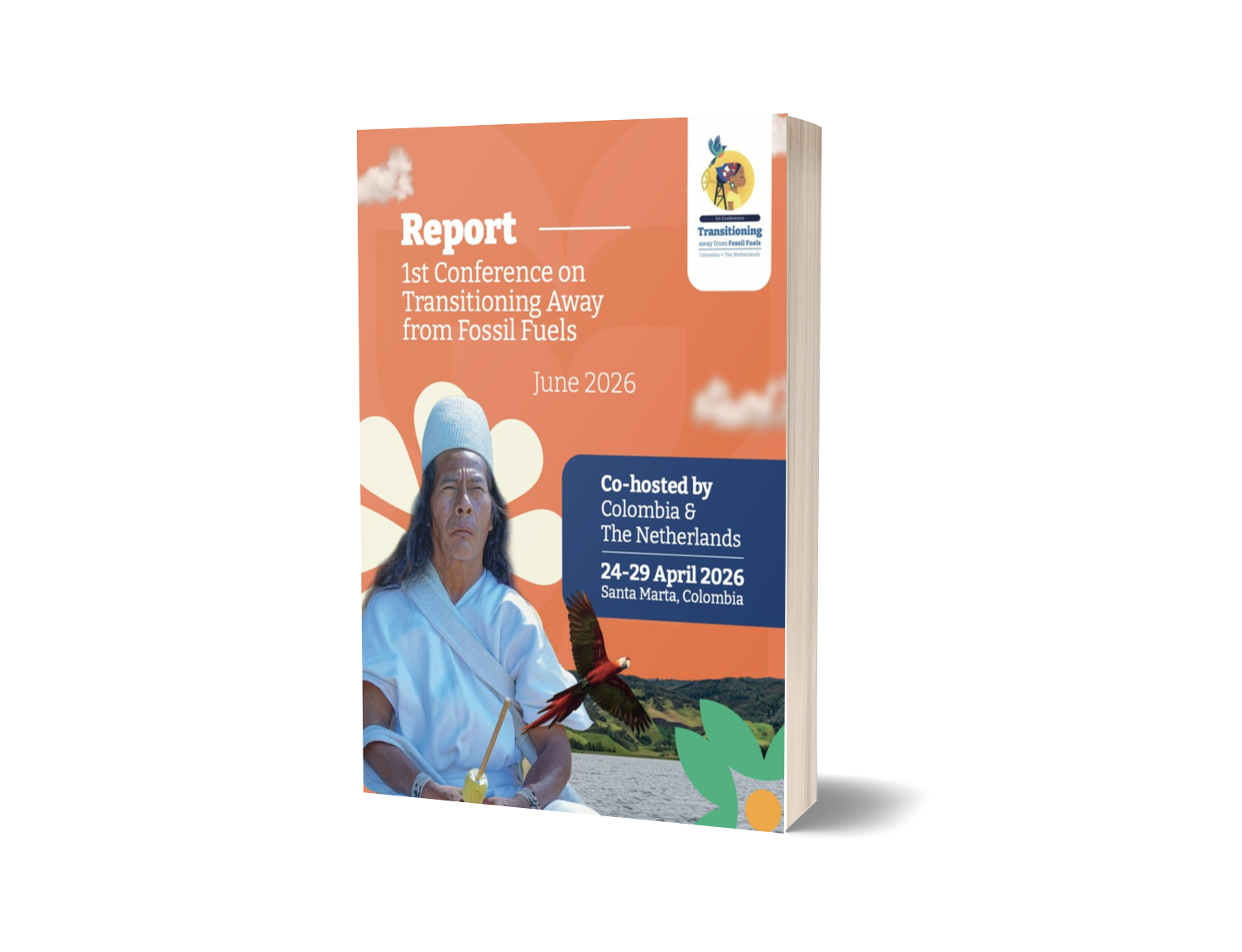
In June 2026, the Governments of Colombia and the Netherlands released the Co-Hosts Outcome Report of the First International Conference on Transitioning Away from Fossil Fuels.
The 176-page report synthesises the inputs of a process that has already convened 57 countries and thousands of rightsholders and stakeholders from 14 sectors that participated in the Santa Marta Conference, and the prior submission and dialogue processes.
The report is the most substantive, detailed and comprehensive document on transitioning away from fossil fuels ever produced by a multilateral process or conference, and marks a historic breakthrough – moving the international policy discussion from if the world should discuss a fossil fuel phase out, to how to scale the international cooperation required to make the transition fast, fair and financed.
The majority of the content of the report is a reflection of what was said by states and sectors in their submissions or during the conference, rather than being negotiated outcomes agreed to by attendees or the formal position of the Co-Hosts. The exception to this is the hosts announcement of a 10-point ‘Santa Marta Vision’ and the Co-Hosts ’ identification of the 5 pathways and action items, outlined below.
The ‘Santa Marta Vision’
The Executive Summary of the report outlines 10 points that make up ‘the Santa Marta Vision’. Overall, the vision paints a clear picture of the need for a holistic economic transformation to end fossil fuel dependency, supported by national roadmaps and international cooperation. Many of the elements of the vision strongly support the case for negotiation of a Fossil Fuel Treaty, in particular:
-
A coalition of doers ‘goes beyond the lowest common denominator. Meaningful progress often begins with a small group prepared to move forward’ (point 2).
Success ‘requires action both within and beyond’ the UNFCCC. ‘It will be equally important to address existing governance and implementation gaps through additional mechanisms, initiatives and agreements’ (point 9).
‘With plurilateral action, grounded in multilateral consensus, we can build the practical pathways to move forwards together (point 10).
-
‘accelerated progress requires stronger governance and action across multiple policy domains… Ensuring that all countries and communities can benefit requires stronger governance, international cooperation, and reforms to address barriers and implementation, to generate further ambition’ (point 3).
‘Transforming energy supply and demand requires coordinated planning across the global energy system and economy’ (point 5).
-
‘It is a broad economic, political, social, and institutional transformation, from the global to the local level, to overcome structural dependencies’ (point 4).
‘Transforming energy supply and demand requires coordinated planning across the global energy system and economy’ (point 5).
-
‘Domestic action and international cooperation, as well as improving conditions to enable these, are equally indispensable to the Transition Away from Fossil Fuels. Progress depends on system-wide coherence. At the heart are new or strengthened national or regional TAFF roadmaps, aligned with 1.5°C, that signal clear direction, to markets as well as domestic and international partners. This needs to be coupled with additional work on sustainable trade flows and advance green economic transformation. Pooling capacities, knowledge and resources across countries can generate significant synergies and speed up progress’ (point 7)
‘Overcoming economic dependence on fossil fuels and boosting green economic transformation requires addressing a complex web of domestic and international constraints that operate differently across countries. Countries willing to accelerate the transition currently face conditions that differ. For some, addressing debt burdens, high costs of capital, limited fiscal space, technological barriers and investment frameworks are essential’ (point 8).
Nations call for a Treaty
The hosts’ Synthesis of Government Positions identifies “A binding fossil fuel treaty that could establish commitments to phase out fossil fuels and end new licensing; create cooperative mechanisms including a buyers-sellers partnership, a debt resolution facility, and scaled-up public finance; redirect financial flows away from fossil fuels; and provide finance and technical support for national phase-out and just transition plans in complement to the Paris Agreement” as an enabler of the transition.
The Co-Hosts also used participation in the Fossil Fuel Treaty Initiative as a selection criterion for invitations to countries to attend the Conference (p. 40).
Many states included strong calls for a Fossil Fuel Treaty in submissions, High Level Segment speeches and dialogue contributions, with the report specifically mentioning:
🇬🇭 Ghana
‘Ghana acknowledged the leadership shown at the conference, stressed that no country can do the transition alone, and called for a fossil fuel treaty to create the necessary architecture for a just transition, with greater accountability building on the Tuvalu framework and beyond (IISD, 2026).’ (P48)
🇵🇦 Panama
‘Panama stated we must pave the way for a legal instrument that names what it phases out and how we finance it and while this instrument comes to life, decide on no more fossil fuel infrastructure, and a commitment for fossil-free zones of life.’ (P48)
🇻🇺 Vanuatu
‘Vanuatu, speaking in the context of Pacific Island Developing States, noted the group had sought a net-zero framework at the IMO but that this had been delayed. Vanuatu urged that the coalition not be afraid of legally binding international frameworks and called for a fossil fuel treaty to be incorporated into governance structures moving forward to the next meeting”. (p66)
Ministerial Meeting
While not explicitly mentioned in the Co-Hosts Report, Senior Officials and Ministers from the 18 Participating Nations and a further 10 Observer States convened at a 3-day high-level meeting chaired by Colombia to discuss advancing the Fossil Fuel Treaty proposal during the Santa Marta Conference. Including new engagement from Ghana, Jamaica, Kenya, Malawi, Maldives, Nepal, Panama, the Dominican Republic, and Saint Lucia.
Sectors call for a Treaty
80% of the Synthesis Reports of contributions from sectors mentioned the need to negotiate a new international instrument to manage a global just transition. The report includes many strong mentions of calls from sectors to negotiate a Fossil Fuel Treaty:
NGOs
‘NGOs called for an ambitious, just, and adequately financed transition away from fossil fuels aligned with the 1.5°C goal. The intervention emphasised the need to phase out fossil fuel production and consumption, reform the financial architecture through grant-based climate finance and debt relief, and prevent the influence of fossil fuel interests in multilateral processes. It also advocated for a legally binding treaty to support a rights-based and funded transition, while stressing that affected communities, civil society, and vulnerable groups must play a central role in shaping the pathway forward.’ (p49) and ‘The NGO Sector called for a strong global architecture that excludes false solutions, the negotiation of a fossil fuel treaty, and a reengineering of the global financial architecture, stressing that the transition is coming and the question is whether it will be just’ (p63)
Social movements
‘Calls on the conference co-hosts, Colombia and the Netherlands, to actively champion the structural reforms needed for the Global South in every relevant multilateral forum: expanded concessional finance, reformed multilateral bank governance, technology treated as a global public good, and binding South-South cooperation frameworks that build genuine industrial capacity.’ (p61
Women and diversities
‘To close existing loopholes in fossil fuel governance frameworks that allow fossil fuels to be used to further genocide, war crimes and crimes against humanity, feminists demand mandatory end-use certification requirements for fossil fuels exports in any multilateral fossil fuel treaty framework.’ (p62) and ‘Women and Diversitiescalled for a fossil fuel treaty to extend responsibilities and demanded that states listen to civil society, urging immediate movement toward a legally binding framework’. (p64)
Subnational Governments
‘Closing global governance gaps: Barriers to transition can not be solved through domestic action alone. A stronger, more inclusive international platform is needed to continue this dialogue, potentially including an inclusive fossil fuel treaty.’ (p61)
Trade Unions
‘A central enabler identified is the strengthening of the international governance architecture through binding instruments and/or enhanced cooperation mechanisms. Proposals such as the Fossil Fuel Non-Proliferation Treaty, JETP-type alliances, and multilateral commitments to the gradual phase-out of fossil fuels make it possible to establish clear rules, avoid competitive asymmetries, and align global efforts with climate objectives. Likewise, the creation of global reserve registries and common standards helps improve transparency and evidence-based decision-making. We need to carry out a fundamental reform of the international framework to enable a just transition worldwide, and particularly in the Global South, one that is legally binding and subject to trade union oversight, starting with a Fossil Fuel Non-Proliferation Treaty and continuing with plans to phase out fossil fuels in order to achieve the 1.5-degree target’ (p62) and ‘The international framework must undergo substantial reform to enable a just transition worldwide—and particularly in the Global South—that is legally binding and subject to union oversight, beginning with a Fossil Fuel Non-Proliferation Treaty and continuing with a phased-out plan for fossil fuels to meet the 1.5-degree target.’ (p127)
Detailed analysis of the report
For more detailed analysis of the report, its strengths, gaps and omissions – see this scorecard analysis from the People’s Summit for a Fossil Fuel Free Future that compares the outcome report with the demands of civil society.
While the strong call to increase international cooperation on the transition, including through the negotiation of a Fossil Fuel Treaty, has substantial momentum in this process there are many other areas that require more significant attention from the hosts of the Second Conference across equity, differentiated timelines, Indigenous Peoples’ rights, transition finance, workers rights, gender justice, ISDS, reducing corporate influence and avoiding dangerous distractions that aim to support expansion of the fossil fuel industry.