PROGRESS
18 governments from around the world are now joined together in a call for a global just transition to manage a fast, fair and fully financed phase out of oil, gas and coal via a Fossil Fuel Treaty
Building a bloc of nationsFossil fuels are the main driver of climate change, yet oil, gas and coal aren’t being directly addressed in UN climate negotiations, and there is no global plan to phase them out. Nations least responsible for carbon pollution are paying the biggest price when it comes to climate, health and security impacts.
A group of first mover nations have decided there is no time to waste. They support the three pillars of the proposed Fossil Fuel Treaty and are advocating for other nations to join them.
At UN climate meetings, one single country can veto action given the consensus model. That’s why these first movers are taking negotiations outside of UN processes so real progress can be made to determine how a just transition can take place, including the finance and legal mechanisms needed to ensure no country or community is left behind.
History proves that achieving a Fossil Fuel Treaty is possible. From landmines to ozone depleting chemicals - politics, economics and social norms can change when a group of first mover political leaders and countries, spurred on by civil society and ordinary people, decide to look at threats to humanity for what they are - and do something about it.
5 Phases towards a Fossil Fuel TreatyThese five phases outline the process of how we achieve a Fossil Fuel Treaty, from development and consensus building, to the final ratification and implementation of a final text.
-
In this first phase, the Fossil Fuel Treaty grew our campaign, through building support for the demand, engaging the public, key movements, civil society and media. The Treaty Initiative also enlisted our coalition and expert groups to design Treaty principles. Experts produced and expanded our research and evidence base that demonstrated a need for the phase out of fossil fuels.
-
In the second phase of the Initiative, we are working to build support from a bloc of first mover countries and UN agencies. This also includes building consensus in regional groupings such as the Pacific Islands Forum, Nordic Council, AOSIS, and CARICOM. The Fossil Fuel Treaty also is convening participating and observing nations in high-level dialogues.
-
In the third phase towards a Fossil Fuel Treaty, the Initiative will work on securing formal negotiating mandate inside or outside UN. There will also be convenings of working groups of diplomats.
-
The fourth phase of the Fossil Fuel Treaty centers around negotiations, which are likely to span several multi-week meetings over 12-24 months. During this phase, we will work to ensure the Treaty meets all 3 pillars and principles of the Initiative and finally the ratification of a treaty on fossil fuels.
-
The final phase of the process will include a monitor progress of three pillars, including via a Global Registry of Fossil Fuels. Additionally, the Initiative will work with ally countries and continue to bring more nations in to become members.
Participating NationsClick to learn more about the nations participating in the negotiations towards a Fossil Fuel Treaty.
-
Antigua and Barbuda joined Timor-Leste to become the 7th and 8th nations calling for a Fossil Fuel Treaty in 2023, and the first countries outside of the Pacific region. The announcement was made from the stage of the Global Citizen Festival in New York in September 2023.
Hon. Gaston Browne, Prime Minister of Antigua and Barbuda, said in his speech:
"The climate crisis is the most existential threat facing all humanity. It doesn't distinguish between European forests and Caribbean waters. Some carry the burden more than others, as in the case of small Islands developing states. This is why today I'm honoured to announce that Antigua and Barbuda join our Pacific friends in calling for a negotiation of a Fossil Fuel Treaty."
Press Release | Two More Countries Join Growing Bloc of Nations Calling for a Fossil Fuel Treaty
-
The Bahamas was the 15th country to endorse the call for a Fossil Fuel Treaty in December 2024.
Philip Davis, The Bahamas’ Prime Minister:
“The rise in global temperatures of more than 1.5°C this past year has put us in a new reality. Real effort, serious action, tangible progress – these are the only paths to sustainable solutions. We must prioritise energy solutions around sources of renewable energy. We need a renewed commitment to collective, multilateral action."
Pakistan and Bahamas join push for global pact to phase out fossil fuels
-
The Kingdom of Cambodia was the 18th country to call for a Fossil Fuel Treaty. It did so during a high level briefing regarding the treaty initiative at COP30.
H.E. Soung Sophorn, Secretary of State, Council of Ministers of the Kingdom of Cambodia, said:“It is my honour to address this High-Level Meeting on the Fossil Fuel Treaty. Cambodia welcomes this important global initiative, which aligns with our national direction toward a low-carbon, green economy, climate-resilient future. Cambodia supports the Fossil Fuel Treaty as a tool to accelerate global ambition. We believe its goals are essential to safeguarding our planet and protecting vulnerable communities.”
Press Release | Cambodia Joins the Fossil Fuel Treaty Initiative as the 18th Participating Nation at COP30
-
Colombia was the 10th country to call for a Fossil Fuel Treaty and did so at COP28 in 2023. Colombia was the first country in Latin America to join the call and the largest fossil fuel producer.
During his speech at COP28, Gustavo Petro, President of Colombia, declared, “Today we face an immense confrontation between fossil capital and human life. And we must choose a side. Any human being knows that we must choose life. I have no doubt which position to take: between fossil capital and life, we choose the side of life."
Since calling for a Fossil Fuel Treaty, Colombia halted licensing of new fossil fuel projects and is developing a just transition away from oil, gas and coal.
At COP30 in 2025, Colombia announced it would host, along with The Netherlands, The First International Conference on a Just Transition From Fossil Fuels in April 2026.
Press Release | Colombia joins international alliance calling for treaty to end use of fossil fuels
-
The Federated States of Micronesia was the 14th nation to call for a Fossil Fuel Treaty. It did so at the United Nations General Assembly in 2024.
During his speech at the general debate of the 79th UN General Assembly, President Wesley Simina of FSM underscored the urgency of the climate crisis for his nation: “As we take action on non-CO2 pollutants, we also need all countries to come together and agree on a global plan to transition away from fossil fuels in a fair, just and equitable manner. In this connection, I am announcing that Micronesia endorses the Fossil Fuel Non-Proliferation Treaty Initiative. We must accelerate all our efforts to tackle the climate crisis.”
Press Release | Micronesian President calls for global solidarity at UN General Assembly
-
Fiji called for a Fossil Fuel Treaty in 2023 at the UN climate talks in Bonn, making it the 4th country to do so. This followed Fiji joining with Vanuatu, Tuvalu, Tonga and Solomon Islands in the Port Villa Call for a Fossil Free Pacific in August, 2023.
Press Release | Six Countries Call for Fossil-Free Pacific Energy Mix
-
Naoero became the 12th country to call for a Fossil Fuel Treaty, making its announcement at COP28 in 2023.
In his National Statement at the High Level Plenary of COP28, Mr Reagan Moses, Secretary for Climate Change and National Resilience of Naoero, said: “We are ready to do our part in making the Pacific a fossil fuel-free zone. In this regard, Naoero would like to use this opportunity to join others in calling for a treaty to phase out fossil fuel production.”
Press Release | Naoero and Samoa Join Fossil Fuel Treaty Amid Fierce Debate at COP28
-
In 2023, Niue called for a Fossil Fuel Treaty, making it the 5th country to do so. This happened when Niue joined other countries endorsing the Port Vila Call for a Just Transition to a Fossil Free Future Pacific in 2023 which included the treaty as a demand.
Block of 6 Pacific countries commit to spearhead global fossil fuel phase-out effort
-
Pakistan was the 16th country and first South Asian nation to agree to participating in discussions regarding a Fossil Fuel Treaty. It did so along with The Bahamas at the end of 2024.
Pakistan is one of the 10 nations most at risk due to climate change. They also depend on fossil fuels to provide the majority of their energy, making a fast and fair transition critical.
Pakistan and Bahamas join push for global pact to phase out fossil fuels
-
Palau was the 9th country to call for a Fossil Fuel Treaty which it did at COP28 in 2023.
Surangel Whipps Jr., President of Palau, said in his high-level statement: “Our ocean feeds us, protects us, and defines us. We must protect it in return. We are witnessing the consequences of ignoring the planet’s limits—floods, droughts, heat, famine, death. The solution to the climate crisis requires everyone’s participation. Today, Palau joins Tuvalu, Vanuatu, and other nations in calling for a Fossil Fuel Non-Proliferation Treaty. We are sovereign countries; however we share one planet. We are stronger together, and we must unite, act and deliver to keep 1.5ºC alive!”
Press Release | At COP28, Palau becomes 9th nation state to formally call for a Fossil Fuel Treaty
-
The Republic of Marshall Islands was the 13th country to call for a Fossil Fuel Treaty. It did so at the United Nations Small Islands Developing States 32nd meeting.
Dr. Hilda Heine, President of the Republic of the Marshall Islands, said at the opening plenary of the summit: “Fossil fuels are at the heart of the planetary crisis that we face today. My country is resilient - war, colonialism and nuclear testing have marked our history. We know the dangers that fossil fuels pose, and the absolute necessity of addressing them as the urgent threat they are. We are proud to join the ranks of the countries supporting the Fossil Fuel Non-Proliferation Treaty initiative today.”
Press Release | Fossil fuel use in focus as SIDS4 opens in Antigua
-
Samoa was the 11th country to call for a Fossil Fuel Treaty which happened at COP 28 in 2023.
Hon. Toeolesulusulu Cedric Schuster, Samoa’s Minister of Natural Resources and Environment, said: “For myself, and also for Samoa, we see this as a very important initiative, and we do want to join. This is important. If we’re going to talk about a transition and a fossil fuel phase out this is a mechanism we need. We will join this initiative and we want to continue to advocate in ways that provide the mechanism so that we can continue to have space that will enable us to really put words into actions.”
Press Release | Naoero and Samoa Join Fossil Fuel Treaty Amid Fierce Debate at COP28
-
Solomon Islands was the 6th nation to call for a Fossil Fuel Treaty. It did so first by joining other countries that endorsed the Port Vila Call for a Just Transition to a Fossil Free Future Pacific in 2023.
It was back in 2016 that the first call for an international treaty to phase out fossil fuels took place. This was led by Pacific Island nations after a meeting of the Pacific Island Development Forum held in the Solomon Islands.
Six Island Nations Commit to ‘Fossil Fuel-Free Pacific,’ Demand Global Just Transition
-
St. Kitts and Nevis was the 17th country to call for a Fossil Fuel Treaty. It did so at the Third Senior Officials Meeting of nation states participating in discussions regarding a Fossil Fuel Treaty in Bonn in 2025.
Colincia Levine, Permanent Secretary in the Ministry of Sustainable Development, Environment, Climate Action and Constituency Empowerment, stated: "The opportunity that this initiative provides is both timely and strategic. For Saint Kitts and Nevis, a small island state boldly advancing towards energy sovereignty and climate resilience, this partnership offers a meaningful platform to further shape global dialogue and action, grounded in the lived realities of vulnerable yet determined nations. We welcome the opportunity to collaborate with fellow forward-leaning nations, like us, who are navigating the complexities of development while committing to a managed and equitable transition away from fossil fuel dependency. Because ultimately, it is you, it is me, it is us, it is we, together forging a shared future beyond fossil fuel dependency."
Press Release | St Kitts and Nevis joins global effort for Fossil Fuel Treaty
-
Timor-Leste joined Antigua and Barbuda in the call for a Fossil Fuel Treaty in 2023, making it the 8th nation to do so. Timor-Leste was the first fossil fuel producing country to become part of the group of first mover nations.
H. E. José Ramos-Horta, President of Timor-Leste and and Nobel Peace Prize Laureate 1996, said:
"Our battle against climate change demands collective action. Fossil fuels are the chief culprits, so the world must move away from them. The climate crisis does not share blame equally among nations. Timor-Leste and fellow developing nations contribute the least to climate change, yet we bear the brunt of its immediate environmental and economic impacts. Timor-Leste stands in solidarity with Pacific nations and is formally joining the call for the negotiation of a Fossil Fuel Treaty. Its mission is simple — to halt new fossil fuel ventures, phase out existing ones and fund a fair shift to clean energy. It is more than a climate agreement between nations — it is a health, development and peace accord that can foster genuine well-being and prosperity for all."
Press Release | Two More Countries Join Growing Bloc of Nations Calling for a Fossil Fuel Treaty
-
Tonga was the 7th country to call for a Fossil Fuel Treaty. It did so at the Fifth Pacific Regional Energy and Transportation Ministers’ Meeting in Port Vila in 2023.
Prime Minister Hu'akavameiliku Siaosi Sovaleni said: "Climate change is the single greatest threat to Tonga and Pacific Island countries, and Tonga therefore stands together with our neighbours in calling for urgent action to combat the root cause of this crisis.”
-
Tuvalu was the second country to support a Fossil Fuel Treaty and called on others to do so at the United Nations climate negotiations in 2022.
During his formal address at COP27, Prime Minister Kausea Natano took the main plenary stage and stated: “We all know that the leading cause of the climate crisis is fossil fuels. Tuvalu has joined Vanuatu and other nations in calling for a Fossil Fuel Non-Proliferation Treaty to steer our development model to pursue renewables and a just transition away from fossil fuels.”
Press Release | Tuvalu first to call for fossil fuel treaty at Cop27
-
Vanuatu was the first country to call for a Fossil Fuel Treaty at the United Nations General Assembly meeting in 2022.
In his speech, President Nikenike Vurobaravu said:“We call for the development of a Fossil Fuel Non-Proliferation Treaty to phase down coal, oil and gas production in line with 1.5ºC, and enable a global just transition for every worker, community and nation with fossil fuel dependence.”
This bloc of nation-states is backed by:-
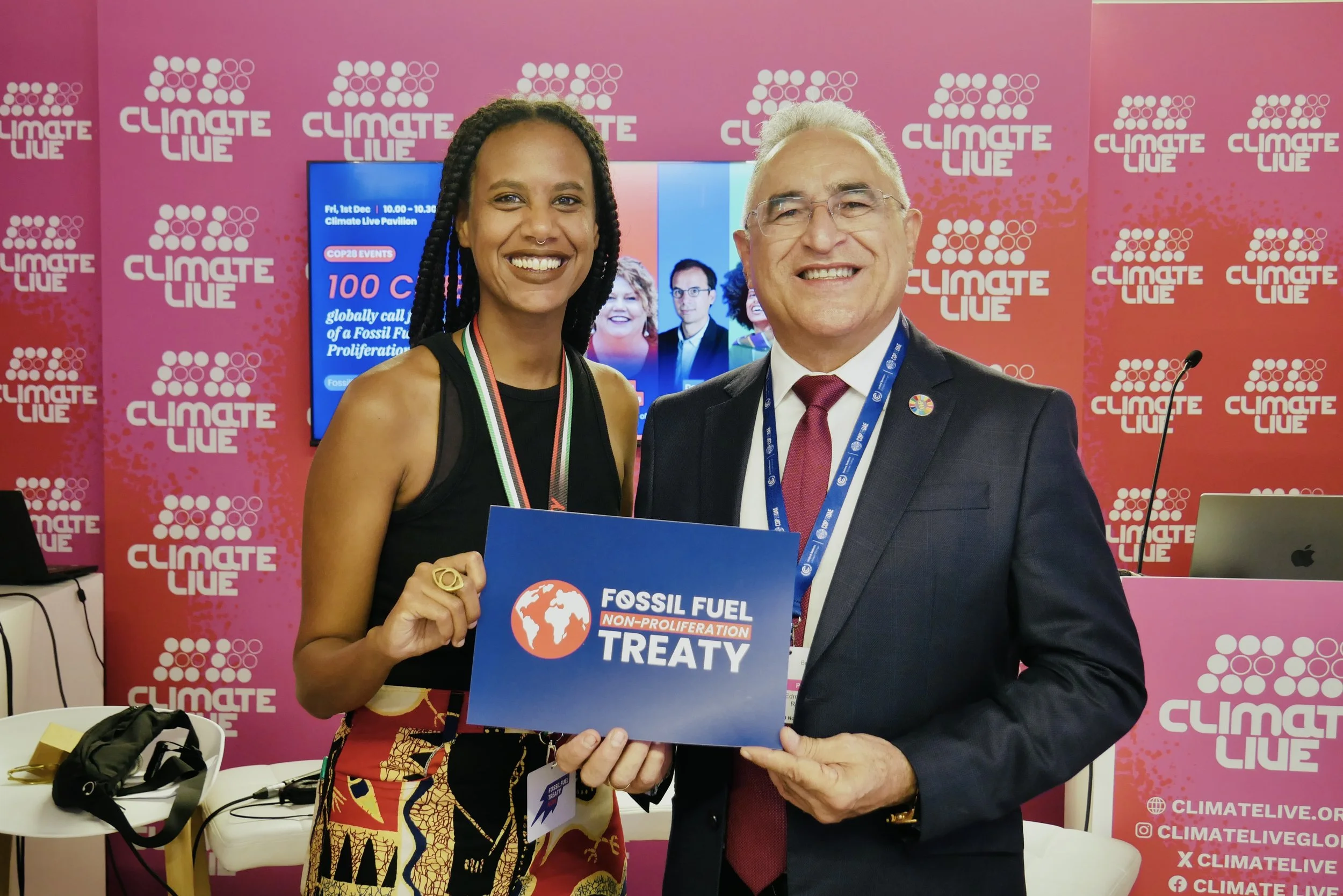
199
Subnational Governments
-
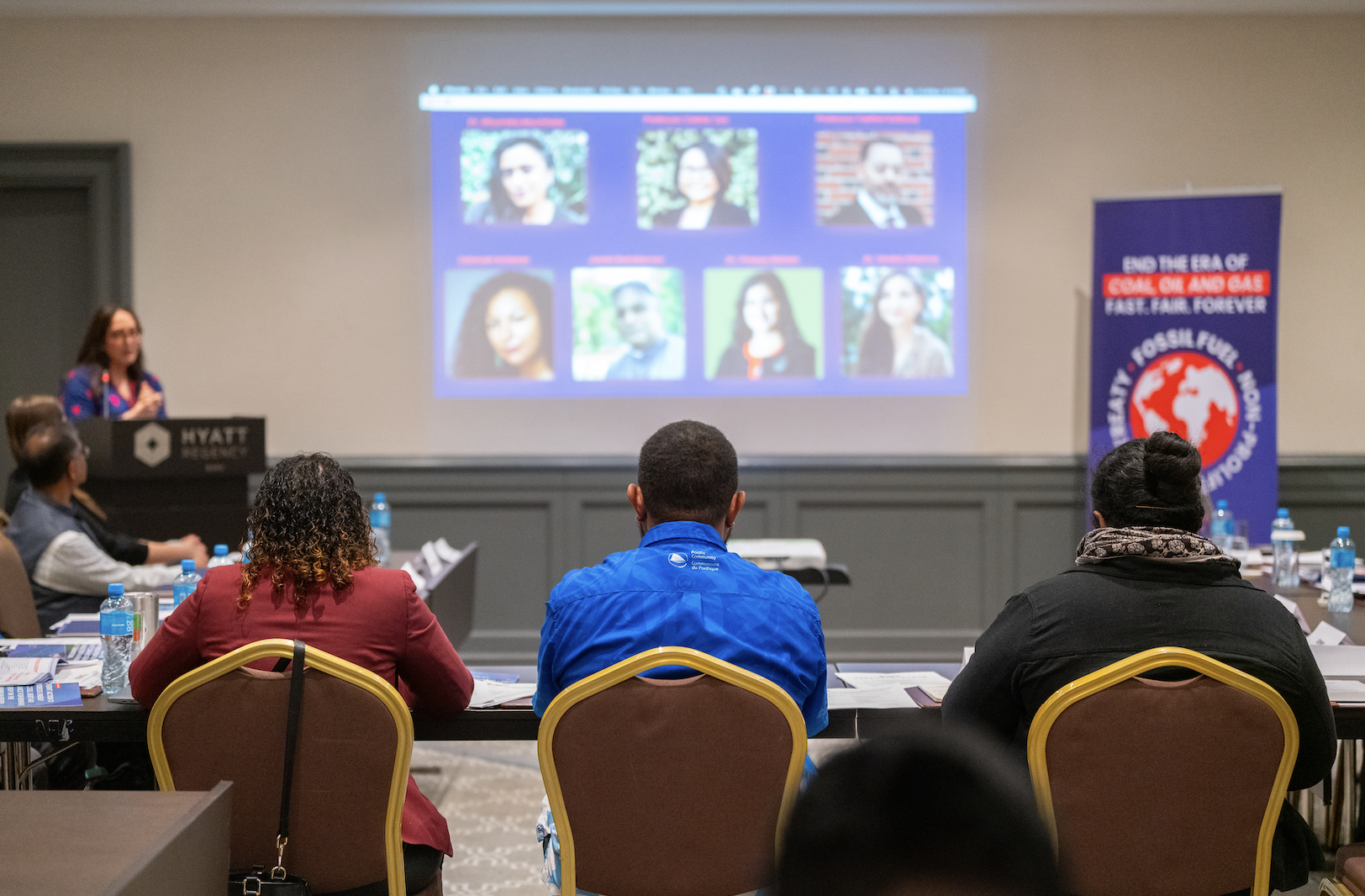
4,380+
organisations, institutions, and businesses
-
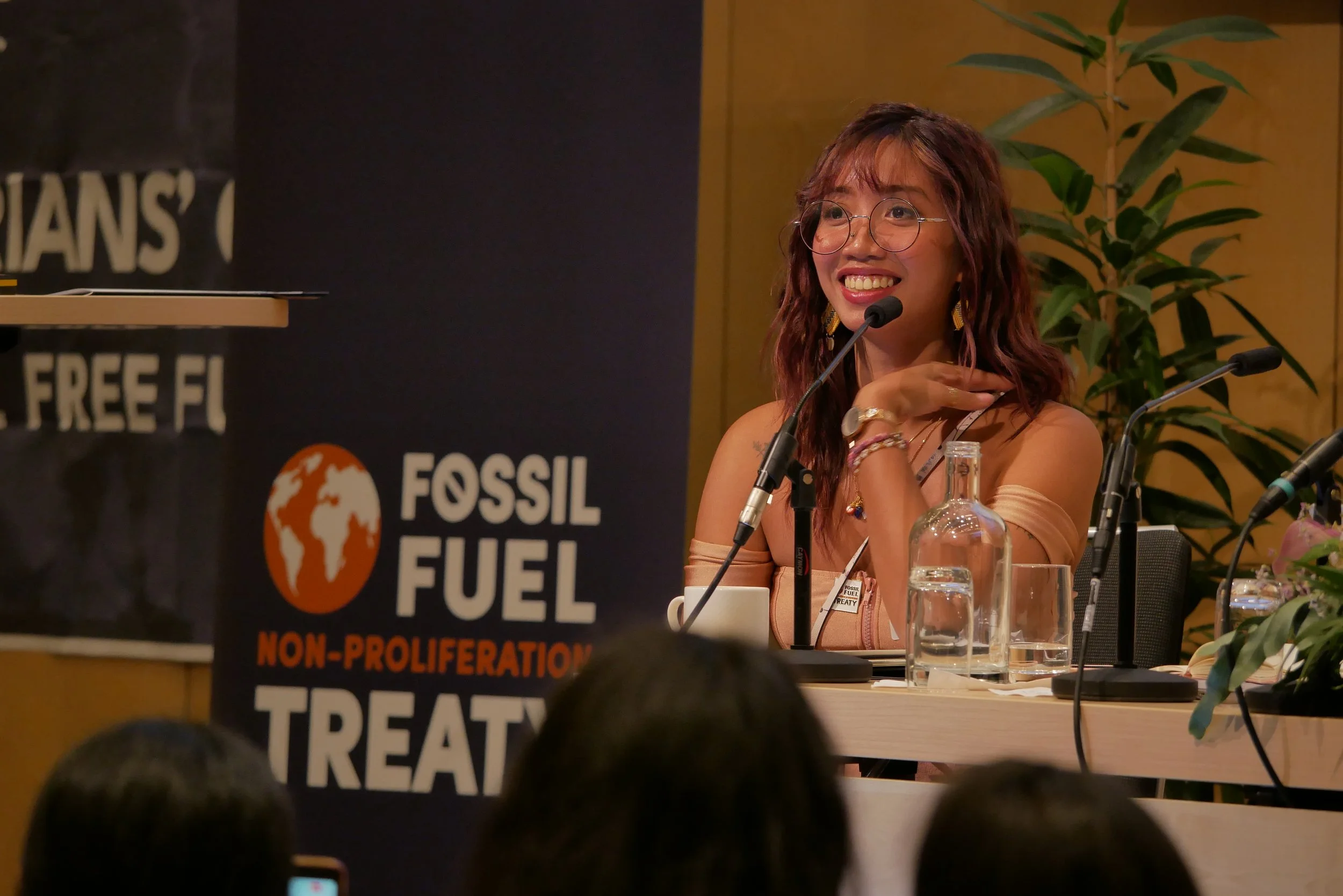
1,095,000+
individuals across the globe
Colombia and the Netherlands will host the First International Conference for a Phase-Out of Fossil Fuels in Santa Marta, Colombia, April 28-29, 2026. The conference will advance international cooperation on transitioning away from fossil fuel extraction — reinforcing the objectives of the Paris Agreement and aligning with the recent Advisory Opinion of the International Court of Justice, which confirmed that States have a legal obligation to protect the climate, including by addressing fossil fuel production, licensing and subsidies.
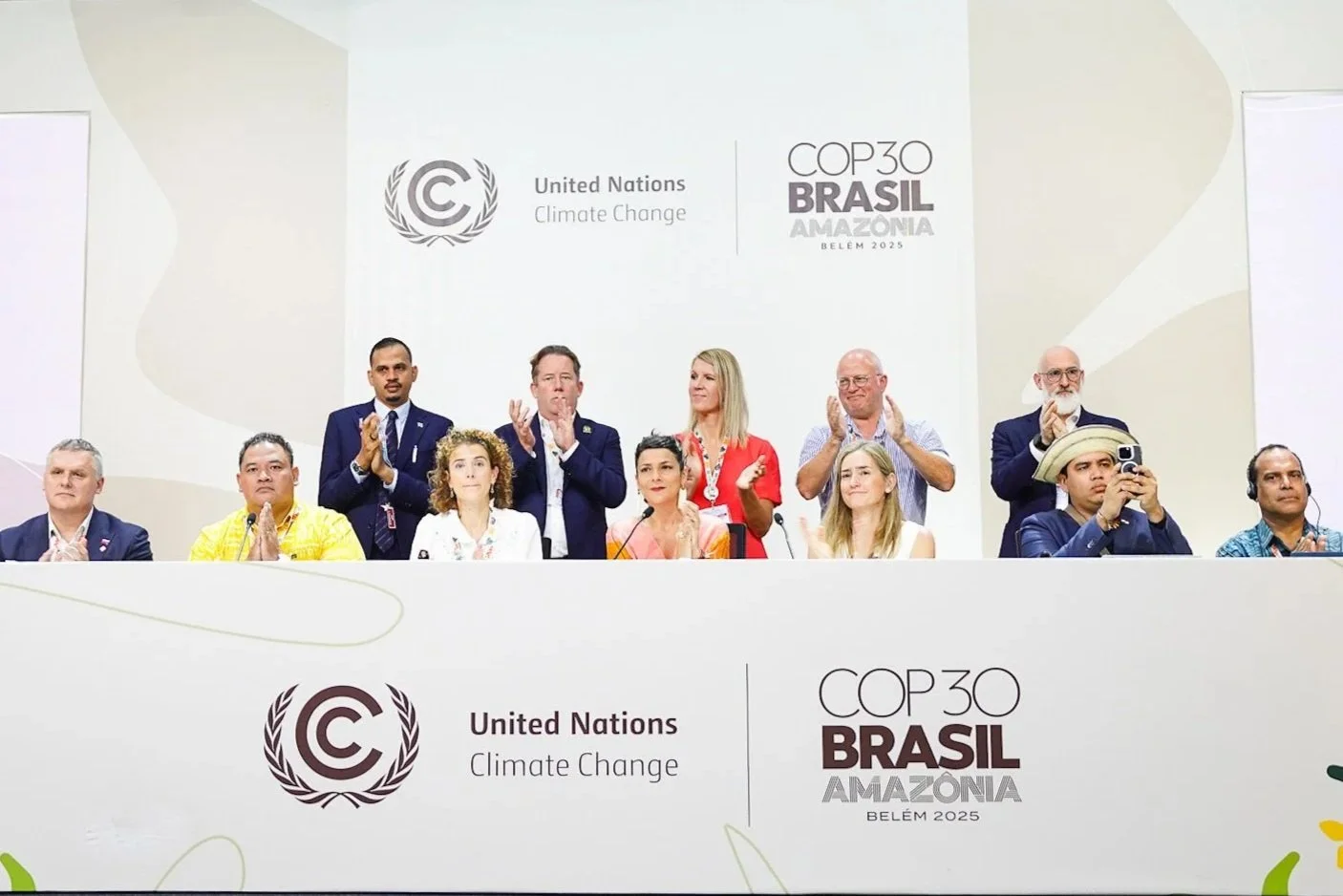
24 countries brought forward the Belém Declaration for a Phase-Out of Fossil Fuels at COP30 in November 2025. The declaration included a call for increased international dialogue and cooperation via the conference in Santa Marta.
Groundbreaking research from the Fossil Fuel Treaty Initiative gives insights on key areas that are relevant for nations, including research on revenue replacement, debt relief and multilateral cooperation.
New and Emerging Research