
Coalition of countries call for Santa Marta Conference to recognise need for a new legal instrument on fair fossil fuel phase out
27 April 2026
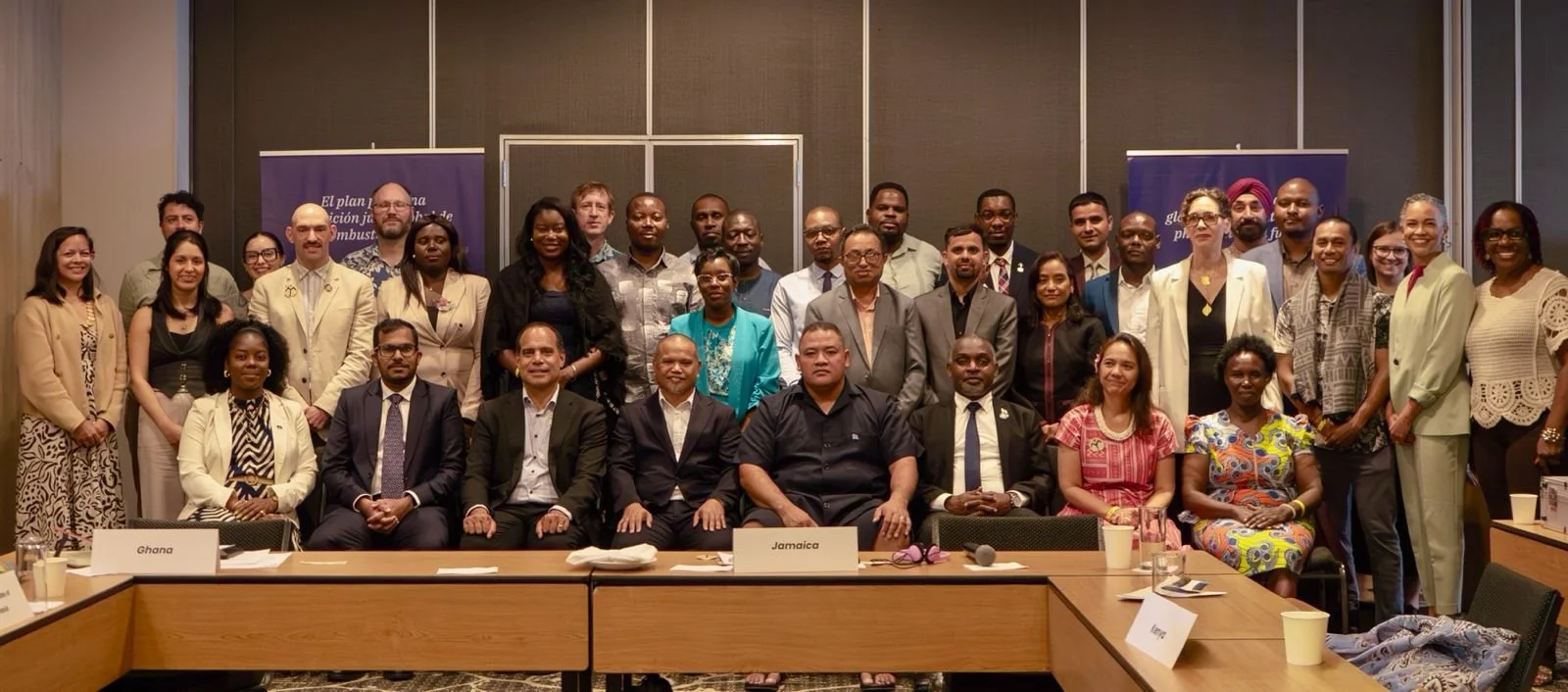
Santa Marta, Colombia, 27 April 2026 — A three-day Senior Officials and Ministerial meeting of the highest ambition coalition pushing for an equitable global fossil fuel phase out — countries participating in discussions on a Fossil Fuel Treaty — has just concluded in the coal port city of Santa Marta. The growing coalition called on the Santa Marta Conference to formally recognise the urgent need to negotiate a new international instrument on fossil fuels — one that would establish binding supply-side obligations, close major governance gaps left by existing frameworks, and create the financial and legal architecture necessary for a globally just transition away from coal, oil, and gas.
The Ministerial Meeting took place ahead of the High-Level Segment of the First International Conference on Transitioning Away from Fossil Fuels, which will be attended by over 60 countries. The meeting was chaired by Irene Vélez Torres, Minister of Environment of Colombia and co-host of the Santa Marta Conference, and attended by Ministers and heads of delegations from Africa, Asia, the Caribbean, Latin America and the Pacific, including representatives from the 18 countries participating in the Fossil Fuel Treaty Initiative.
The meeting was also attended by 10 official observer states — Ghana, Jamaica, Kenya, Malawi, Maldives, Nepal, Panama, the Dominican Republic, and Saint Lucia — the largest number of observers to date, demonstrating the growing momentum for a Fossil Fuel Treaty.
The coalition, which includes frontline states, Small Island Developing States, least developed countries, fossil fuel-dependent importer economies and Global South fossil fuel producers, discussed coordinating action across four priorities:
Recognise the gap in global governance and the need to negotiate a Fossil Fuel Treaty as a concrete recommendation of the Santa Marta Conference, and seek a subsequent formal negotiation process for a binding treaty instrument;
Advance concrete mechanisms for international cooperation and finance, including further developing proposals for an Importers-Exporters Club, a Global Just Transition Fund, and a Debt Resolution Facility to remove barriers to an equitable phase-out;
Welcome the vision of Tuvalu as Chair of the Second Conference for a Just Transition Away from Fossil Fuels, to be hosted in the Pacific region within a year;
Affirm that any negotiated instrument must be grounded in equity, historic responsibility, human rights, and the full and self-determined participation of Indigenous Peoples consistent with the United Nations Declaration on the Rights of Indigenous Peoples.
Hon. Irene Torres, Minister of Environment and Sustainable Development, Republic of Colombia, host of the Ministerial Meeting, said: "Colombia is honoured to host this historic moment, where a coalition of countries ready to act are making it clear that a transition away from fossil fuels is more urgent than ever, and that the countries of the Global South must not pay the price of a crisis they did not cause. That is why we are proud to join nations from across the world in seeking to negotiate a treaty that is anchored in equity, that creates mechanisms for much-needed transition finance, and that gives every country the fiscal space it needs to diversify its economy and power its future. Santa Marta is the beginning of an ongoing process — one that started here on the shores of the Caribbean, and will now advance in the islands of the Pacific.”
Hon. Dr Maina Vakafua Talia, Minister of Home Affairs, Environment and Climate Change, Tuvalu, said:"Tuvalu is not waiting for the rest of the world to act, we are leading the way. The science is clear, the world’s highest court has spoken, and the moral case is unanswerable: we must chart a journey away from fossil fuel production. This historic conference must send an unequivocal signal: the era of fossil fuel expansion is over, and states ready to act must negotiate a binding treaty to make that real. We are proud to offer Tuvalu as the home of the Second Conference for the Just Transition Away from Fossil Fuels, because for us, this is not a negotiating position — it is a matter of survival."
The bloc emphasised that existing multilateral frameworks, while essential, have proven insufficient to drive the pace and scale of fossil fuel phase-out required to stay within the 1.5°C temperature limit. The recent ICJ Advisory Opinion, which found that fossil fuel production, consumption, exploration licences, and subsidies may constitute internationally wrongful acts, was cited as further grounds for an explicit supply-side governance framework.
Hon. Ralph Regenvanu, Minister for Climate Change and Environment, Republic of Vanuatu, said, “From the International Court of Justice, to the UN General Assembly, Vanuatu has championed the legal obligation to phase out fossil fuel production, and we are here in Santa Marta to continue that work with a coalition of countries committed to lead. The world is watching this conference, and we will not leave without progress. For too long, we have debated whether to even mention fossil fuels in climate negotiations, here we can finally move beyond a conversation on ‘if’ to transition to ‘how’. A Fossil Fuel Treaty gives us a binding framework to implement our shared legal obligations into real action: moratoriums on expansion, equitable phase-out timelines, finance mechanisms, and the removal of the legal barriers that trap countries in fossil fuel dependency."
The idea of the Santa Marta conference originated from conversations among the growing group of countries engaged in the Fossil Fuel Treaty Initiative. At a Ministerial meeting in December 2024, these countries agreed to “initiate a series of dedicated conferences” to overcome the political deadlock the transition away from fossil fuels has faced in consensus-based, universal climate negotiations for decades. In June 2025, Colombia, the bloc's largest fossil fuel producer, offered to host the first one. This model has a proven track record, similar to processes like the Ottawa Convention, where focused conferences have united willing states and broken deadlocks to pave the way for binding agreements.
A year later, the group has emerged united around a shared vision for the conference and agreed on shared positions and the next steps to advance an ongoing process parallel and complementary to the UNFCCC, including seeking negotiations on a binding international treaty on fossil fuels. The group also discussed specific obligations that a future Treaty could contain, including proposals on finance mechanisms, debt reform, equity provisions, and addressing the legal risks of Investor-State Dispute Settlement (ISDS) mechanisms.
Hon. Steven Victor, Minister of Agriculture, Fisheries, and the Environment for the Republic of Palau, said, “For thirty years, the frameworks we have built have not been sufficient to stop this crisis and address fossil fuel expansion. The market will not save us. Voluntary commitments will not save us. That is why we are here in Santa Marta — not to replace what exists, but to build something complementary. Every economy has been shaped by fossil fuels. Ours included. We are not naive about the complexity of this transition. But complexity is not an excuse for inaction, and the absence of a dedicated governance framework is not an accident — it is a choice made, again and again. The proposal for a Fossil Fuel Treaty changes that calculus. It can create the legal architecture to hold those most responsible for this crisis accountable, to establish timelines grounded in equity and science, and to ensure that complementary processes reinforce each other.
Juan Carlos Monterrey, Special Representative for Climate Change, Ministry of Environment of Panama, said, “Santa Marta is where the world draws the line. The era of fossil fuels must end, and it must end through an international treaty that delivers a fair, orderly, and irreversible phase-out, one that propels our economies into a green and prosperous future built on millions of new, decent, and future-ready jobs. What we failed to deliver at the UN Climate Talks must now be built here. Santa Marta is where this journey begins.”
Hon. Chipiliro Mpinganjira MP, Deputy Minister of Natural Resources and Climate Change, Malawi, said, "The people of Malawi are facing floods, droughts, and food insecurity driven by the climate crisis and global fossil fuel expansion. We are here in Santa Marta because we believe that the international community must do better. New frameworks for international cooperation and mechanisms to scale transition finance would be transformative for countries like ours — giving us the fiscal space to invest in clean energy and resilient development without sacrificing economic survival. Malawi is actively exploring what participation in such a process could look like, and we urge this conference to open that door."
Cedric Dzelu, Technical Director, Office of the Minister for Climate Change and Sustainability, Ghana, said, "Ghana has so much interest in this discussion. We are mobilising national momentum towards joining the Fossil Fuel Treaty. Earlier this year we hosted a national convening, where we convened all relevant national stakeholders to discuss the proposal for a Fossil Fuel Treaty. I’m happy to report to you that the momentum is positive, and that almost every sector of our economy, our country, ministry, department are in support of us joining the Treaty Initiative. I have come to assure you that certainly very soon Ghana will be a major participant of the Fossil Fuel Treaty, and we also hope that we’ll be a major African mobiliser, starting from West Africa, bringing on board West African countries, and then cutting across Africa. The process of joining the Treaty will need to proceed through the appropriate national procedures, including submission to Cabinet for consideration and approval, followed by Parliamentary review and approval. The Minister is deeply committed to advancing this process and to ensuring that Ghana moves steadily toward becoming a participating nation.”
Esther Wang'ombe, Director of Renewable Energy, State Department for Energy, Ministry of Energy, Kenya said, "Kenya has demonstrated that a fast and ambitious renewable energy transition is not only possible, it is economically advantageous. Kenya is a leader in the promotion of renewable energy. We have built one of the cleanest electricity grids on the continent and we are proud of that. But our transport sector still relies heavily on fossil fuels. We recognise that without the right international governance framework, the pressures to expand fossil fuel production – driven by debt, energy insecurity, and inadequate finance – will undermine the progress countries like ours have made. That is why the conversation happening here about increasing international cooperation on fossil fuels is one Kenya takes seriously. A powerful coalition of countries, working together, grounded in equity and supported by real finance, could unlock the just transition at the scale our climate demands."
Imran Williams, Saint Lucia's Director of Finance, said, “One of the important things we would like to understand is how the tracking of the phase out will happen and the mechanism to be used to ensure that the phase-out is actually happening. When it comes to greenhouse gas emissions we have a proper tracking of year on year progress of that. Something similar is needed for the fossil fuel phase-out, to keep track of progress and the strategies and activities countries are undertaking to support the process. Without this, we risk some nations committing to a phase-out without any concrete evidence of that commitment.”
Ministers noted the acute vulnerability of many countries and communities — including small island developing States, least developed countries, Indigenous Peoples, and other particularly affected communities — who face acute vulnerabilities and existential climate impacts despite contributing the least to the crisis.
The group also called for the conference to reject false solutions — including carbon capture and storage, carbon offsetting, and geoengineering — that would justify the prolongation of fossil fuel production. The group recognised the need to ensure meaningful participation of civil society with robust conflict-of-interest protections against fossil fuel industry interference in future processes, conferences and negotiations.
Meanwhile, thousands of people joined 140+ events in more than 30 countries ahead of the Conference, calling for a fossil fuel phaseout and for countries to support the proposed fossil fuel treaty in Santa Marta. From Port Vila (Vanuatu) to Seattle (USA) through Kampala (Uganda), Abuja (Nigeria), Freetown (Ghana), Addis Ababa (Ethiopia), Delhi (India), Dhaka (Bangladesh), Oslo (Norway) and 40 German cities, people have organized local assemblies and panels, marches and street actions, painted street murals and projected their messages on public buildings.
About the Fossil Fuel Treaty InitiativeThe Fossil Fuel Non-Proliferation Treaty Initiative is spurring international cooperation to end new development of fossil fuels, phase out existing production within the agreed climate limit of 1.5°C and develop plans to support workers, communities and countries dependent on fossil fuels to create secure and healthy livelihoods. For more information on the Fossil Fuel Non-Proliferation Treaty Initiative and proposal, access here.
Media ContactsNathalia Clark
Communications Director, Fossil Fuel Treaty Initiative
nathalia@fossilfueltreaty.org
+55 61 99137-1229
Michael Poland
Campaign Director, Fossil Fuel Treaty Initiative
michael@fossilfueltreaty.org
+61 419 581 748