
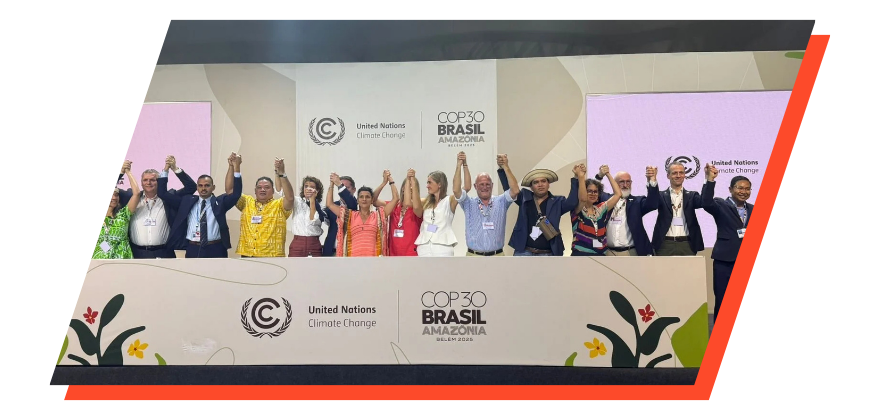
THE FIRST CONFERENCE ON TRANSITIONING AWAY FROM FOSSIL FUELS
The Road to Santa Marta:
Securing a Global Framework to End the Fossil Fuel Era
For three decades, global climate negotiations have focused on managing the symptoms of the climate crisis — greenhouse gas emissions — while ignoring the root cause: the unchecked proliferation of coal, oil, and gas.
While the UNFCCC and the Paris Agreement are essential forums for global climate action, their consensus-based structures allow blockers backed by polluting industries to stall necessary action on fossil fuel production. Now, we have a vital opportunity to break this deadlock.
In April 2026, Colombia and the Netherlands will convene the First Conference on Transitioning Away from Fossil Fuels in Santa Marta. The conference is the first of a “series of conferences” agreed to by the 18 nation-states participating in the development of a Fossil Fuel Treaty, and will be a solutions-focused forum operating outside the auspices of traditional international climate architecture.
The current wars in Ukraine and the Middle East, fueled by a thirst for fossil fuel revenues, do not sideline the transition debate; they radically reinforce its necessity. Because fossil fuel production is so structurally embedded in global markets, financial systems, and geopolitics, no single country can manage this transition alone. Coordinated international cooperation, grounded in equity and justice, is essential to prevent disorderly phase-outs, economic downturns, and new forms of energy inequality.
The demand to transition away from fossil fuels is no longer only a whisper that many don’t have the courage to say out loud; it’s a universal cry for survival: we need to equitably move away from the extraction plotting our destruction. We need a global transition away from fossil fuels that is fast, fair, and financed — one that strengthens energy sovereignty, stabilises economies, and supports workers and communities, leaving no one behind.
All countries now face a stark choice: either unite to forge equitable new forms of international cooperation to deliver a fast and funded transition away from fossil fuels, or remain dangerously vulnerable to volatile supply shocks and the global conflicts they fuel.
The Santa Marta Conference is the decisive opportunity to strengthen international cooperation by finally confronting these interconnected crises at their shared source. It is a historic turning point in climate diplomacy, and a fundamental act for global stability. Tired of waiting for an elusive consensus, committed, high-ambition nations are coming together, ready to move from incremental pledges to concrete action.
They will champion coordinated solutions, including strengthening multilateralism to address the threat of fossil fuel extraction. This is why a global coalition of nation-states, subnational governments, Indigenous peoples, scientists and civil society will arrive in Santa Marta calling for countries to participate in the development of a Fossil Fuel Treaty as a key outcome of the summit.
-
For three decades, global climate negotiations have focused on managing the symptoms of the crisis — emissions — while ignoring its root cause: the unchecked proliferation of oil, gas, and coal extraction. This blindspot has fueled a devastating polycrisis: climate breakdown, economic instability, conflicts, and energy imperialism. These are not separate issues; they are interlinked fires, all caused by the same spark — fossil fuel dependence.
The science is unequivocal. For the last decade, oil, gas, and coal have been responsible for 86% of the CO2 pollution heating our planet, as well as causing 1 in 5 deaths worldwide from fossil fueled-air pollution. Yet, government and industry plans are set to ramp up extraction, putting us on a path to produce 120% more fossil fuels by 2030 than what is safe for 1.5°C. We are racing in the opposite direction of science and safety.
The damage extends far beyond climate change. Their entire lifecycle — from extraction to combustion — undermines global health, security, and justice, driving unprecedented impacts on Indigenous Peoples, biodiversity, communities, lives, livelihoods and cultures; economic instability from volatile energy markets, supply shocks, and debt entrapments; as well as geopolitical pressure and conflicts over outdated, finite and dangerous resources.
The current wars in Ukraine and the Middle East, fueled by fossil fuel revenues and geopolitics, do not sideline the transition debate; they radically reinforce its necessity. Because fossil fuel production is so structurally embedded in global markets, financial systems, and geopolitics, no single country can manage this transition alone. Coordinated international cooperation, grounded in equity and justice, is essential to prevent disorderly phase-outs, economic downturns, and new forms of energy inequality.
The demand to transition away from fossil fuels is no longer only a whisper that many don’t have the courage to say out loud, it’s a universal cry for survival: we need to equitably move away from the extraction plotting our destruction. We need a global transition away from fossil fuels that is fast, fair, and financed — one that strengthens energy sovereignty, stabilizes economies, and supports workers and communities, leaving no one behind.
The Santa Marta Conference this April is the decisive opportunity to strengthen international cooperation by finally confronting these interconnected crises at their shared source. It is a historic turning point in climate diplomacy, and a fundamental act for global stability. Tired of waiting for an elusive consensus, committed, high-ambition nations are coming together, ready to move from incremental pledges to concrete action.
They will champion coordinated solutions, including strengthening multilateralism to address the threat of fossil fuel extraction. This is why a global coalition of nation-states, subnational governments, Indigenous peoples, scientists and civil society will arrive in Santa Marta calling for countries to participate in the development of a Fossil Fuel Treaty as a key outcome of the summit.
-
In Santa Marta, empty promises are not invited. The world will judge this conference by a single measure: whether it delivers concrete, integrated action on the three pillars essential for a just transition. This is not about negotiating a text, but forging a new diplomatic reality, with a global coalition of countries ready to work together to manage a fast, fair and financed phase out of fossil fuels outside the barriers of consensus-based negotiations.
This begins with economic liberation — overcoming economic dependence and breaking the debt-fossil fuel trap. We cannot ask Global South nations to abandon fossil revenues while they are strangled by the debts used to extract them. A just transition is impossible without systemic debt relief and direct, scaled financial support from historical emitters who made their wealth through burning fossil fuels since the Industrial Revolution. This is not aid; it is owed reparations, the foundation for building sovereign, productive economies that liberate people from volatile markets and extractivism.
Simultaneously, we must ignite a fair and fast transformation of fossil fuel supply and demand. The first, non-negotiable step is a global halt to new fossil fuel extraction — the definitive signal to redirect trillions toward accessible, decentralized renewable energy. But speed without equity is meaningless. An inequitable transition is an impossible one. Nations with greater dependence and less capacity cannot build a new future unless they receive the finance and the time to do so; without it, they are locked into the past. Wealthiest nations must move first, leading the phase-out and ending the perverse logic of subsidizing our own destruction. Redirecting vast public funds from the pockets of big polluters is a fiscal and moral win, building true energy security for all — one that cannot be weaponized or withheld.
Ultimately, this is about advancing international cooperation as the final act of strategic peacemaking. Fossil fuels are the currency of conflict, funding wars and fueling geopolitical coercion while their extraction has also driven the erosion of traditional cultures, territories, ecosystems and ways of life that have sustained life on this planet. By cooperatively managing their decline, we undertake one of the most significant global de-escalations in history. Santa Marta is thus not merely a climate conference; it is where we must choose to strengthen a multilateralism rooted in shared survival, where diplomatic action unites with civil society and grassroots’ voices, and Indigenous leadership.
In Santa Marta, we are not just transitioning energy systems; we are laying the foundations for a more stable, peaceful, healthy, and safe world. This requires ensuring Santa Marta isn’t a one-off meeting, but the start of an ongoing multilateral process uniting the highest ambition coalition of nations ready to address the threat of fossil fuels and closing the governance gaps, including through advancing the negotiation of a Fossil Fuel Treaty.
-
Santa Marta is not an isolated event but the launch of a decisive diplomatic wave, and a major step toward the negotiation of a global framework on transitioning away from fossil fuels. The decision to hold a series of global conferences, including this first summit in Colombia, was made by the 18 countries participating in the Fossil Fuel Treaty Initiative.
This builds on the proven model of international conferences that addressed other major global threats like landmines, ozone-depleting chemicals, and nuclear weapons — conferences that shifted narratives and changed history. We are now leaving Colombia with an unambiguous political mandate: to establish, within a year, formal negotiations for a Fossil Fuel Treaty, a binding international framework to manage a global just transition and an equitable fossil fuel phase-out, with the key next step being a second international conference in the Pacific, hosted by Tuvalu.
The Treaty framework is the logical, necessary outcome of the action forged in Santa Marta. It is championed by an unprecedented alliance of nation-states, subnational governments, parliamentarians, civil society, health and faith leaders, Indigenous communities, trade unions, scientists, and youth, and is reinforced by the recent International Court of Justice Advisory Opinion (ICJAO) and major institutions like the European Parliament, the World Health Organisation (WHO) and the International Union for Conservation of Nature (IUCN). It provides a concrete mechanism to complement and reinforce the Paris Agreement.
A Fossil Fuel Treaty is the most comprehensive articulation of an actionable, timebound and legally binding global plan for a just transition away from fossil fuels, with equity and justice at the center. Accelerating a global just transition is the most urgent act of courage of our time. It is the foundation for a livable, healthy, fair, and peaceful future that humanity and our planet desperately needs. This collective journey begins in Santa Marta.
Key Events by the Fossil Fuel Treaty and Partners during the First International Conference on Fossil FuelsThe Path Forward:
From Colombia to the PacificThe Santa Marta conference is not a standalone event, but the crucial first step toward formal Fossil Fuel Treaty negotiations.
Our primary goal for the conference outcome is clear: the official conference outcome must acknowledge the need for negotiation of a new international treaty to regulate fossil fuels and kickstart a process for willing countries to tackle fossil fuels in parallel to the UNFCCC.
Achieving this milestone in Santa Marta will build the groundwork for a second international conference — to be hosted by Tuvalu in the Pacific within a year — where a formal mandate to negotiate a Fossil Fuel Treaty can be secured.

Our Vision for Santa Marta At Santa Marta, we are not interested in empty or vague promises. We are calling on a global coalition of nation-states, subnational governments, Indigenous peoples, and civil society to advance toward negotiation of a binding Fossil Fuel Treaty as a critical framework to implement commitments to transition away from fossil fuels. To succeed, this transition must deliver on three core fronts:
-
We cannot ask Global South nations to abandon fossil fuel revenues while they are strangled by debt. A just transition is a debt owed, not charity given. A Treaty would establish cooperative mechanisms, such as a Debt Resolution Facility to relieve the debt burdens that lock developing countries into fossil fuel dependence, and a Global Just Transition Fund, to break the debt-fossil fuel trap, finance economic diversification, protect vulnerable workers and communities, and ensure that historical polluters pay their fair share. A Treaty could annul Investor-State Dispute Settlement (ISDS) provisions that currently allow fossil fuel corporations to block ambitious domestic climate policies.
-
The first, non-negotiable step is a global halt to new fossil fuel extraction, avoiding the creation of risky stranded assets. Wealthy nations must lead this phase-out. Trade relationships between fossil fuel producers and consumers are a powerful connection to build on to create incentives to support economic diversification and planning and to allow both sides to accelerate their transition away from these deadly fuels.
-
Fossil fuels are the currency of conflict, funding wars, genocide and geopolitical coercion. By cooperatively managing the decline of fossil fuels and investing in decentralised, accessible renewable energy, we are undertaking one of the most significant global peace projects in history and laying the foundation for true, lasting security.
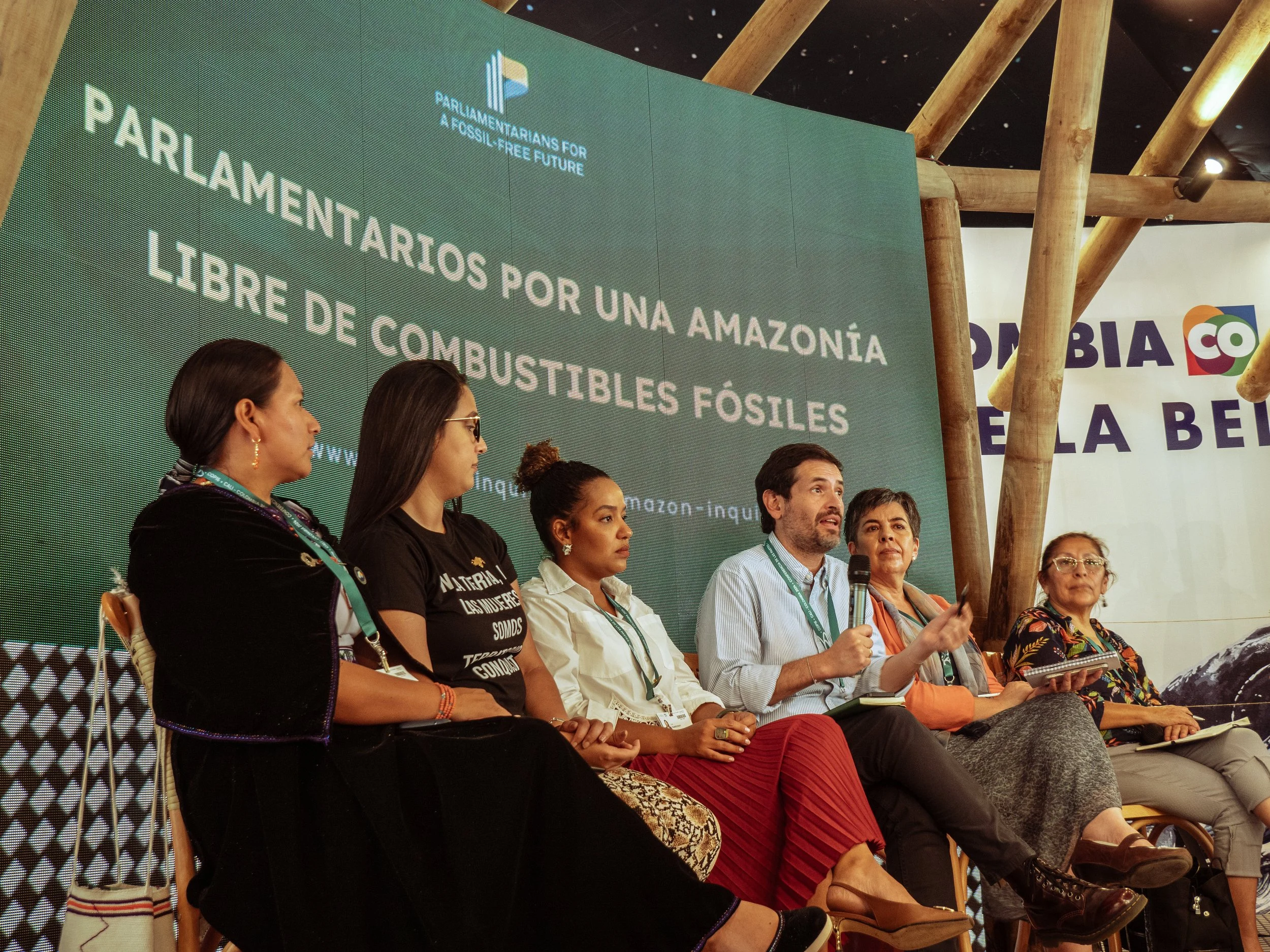
Without an international framework to enable a managed phase-out, the decline of fossil fuels will be chaotic, imposing devastating costs on workers, frontline communities, and fossil-fuel-dependent nations who will also face worsening climate impacts caused by burning fossil fuels. A legally binding Fossil Fuel Treaty will act as a necessary umbrella framework to manage this transition fast and fairly.
In Santa Marta, we will be advocating to secure the strongest political signal yet to advance toward a negotiating mandate for a Fossil Fuel Treaty that establishes binding commitments on supply and unlocks concrete cooperative mechanisms.
We are not advocating to throw out everything that has so far been achieved by climate diplomacy. A Fossil Fuel Treaty can instead complement and help achieve the emissions targets of the Paris Agreement, and the dialogue generated by the COP30 Belém Roadmap, providing the missing legal obligations. The Belém Roadmap and the proposed Fossil Fuel Treaty are parallel, mutually reinforcing initiatives that serve different but complementary roles. While the Belém Roadmap is a political dialogue and non-binding process initiated by Brazil as the COP30 President to help countries identify transition barriers and develop national phase-out plans, the proposed Fossil Fuel Treaty would establish global legally binding commitments to halt fossil fuel expansion and create the international financial mechanisms — like debt relief and a Global Just Transition Fund — needed to actually implement those national phase-out plans.
The Roadmap builds political will and outlines what national transitions should look like, while the Fossil Fuel Treaty development process can turn those concepts into actionable, binding international law backed by financial cooperation. Both tracks must be advanced simultaneously at the Santa Marta conference to keep alive the possibility of limiting temperature rise to 1.5°C.

The First Conference on Transitioning Away from Fossil Fuels will serve as a strategic space for dialogue among a broad range of stakeholders — including government representatives, experts, rural and Indigenous Peoples, Afro-descendant communities, civil society, climate advocates, industry leaders, and academia — to explore viable, fair, and equitable pathways for transitioning to sustainable, diversified, and accessible energy. Designed to foster robust and structural transformations, the summit aims to facilitate a planned, just, and sustainable phase-out of fossil fuels and address the need for a structural shift in our socioeconomic model.
The decision to hold this first global conference in Colombia was made at a Senior Officials meeting of the countries participating in the Fossil Fuel Treaty Initiative in June 2025 in Bonn. The initiative builds upon successful examples of previous diplomatic summits that have led to increased international cooperation to address major global threats including the Ottawa Conference to address landmines; the Oslo Conference on cluster munitions and the discussions on the Prohibition of Nuclear Weapons, for which a series of three conferences, known as the Humanitarian Initiative, shifted the framing of nuclear weapons from one of security to a humanitarian discourse, leading to successful resolution within the UN General Assembly. The Santa Marta Conference will be followed by a second conference to be held in the Pacific region within a year
Take Action: How You Can Shape the OutcomeA global coalition focusing our demands in Santa Marta on a Fossil Fuel Treaty is strategic and the most viable path forward because it relies on the proven diplomatic model of standalone diplomatic conferences that lead to blocs of high-ambition states bypassing the deadlock of consensus and universal frameworks to negotiate impactful treaties to protect humanity from grave threats.
The Ottawa Conference led to the Mine Ban Treaty, which curtailed the threat posed by the landmine industry. A series of conferences known as the Humanitarian Initiative created the political backing to launch negotiations for the Treaty on the Prohibition of Nuclear Weapons.
We must now apply this approach to fossil fuels: empowering high-ambition countries to establish binding global rules, unlock transition finance, and shift international norms without waiting for universal agreement
Securing a strong political signal at Santa Marta requires the unified power of our global civil society and movement partners. We are calling on the coalition of 4,000 organisations and 1 million individuals who have endorsed the Fossil Fuel Treaty over the past 5 years to take immediate action:
-

Pressure Your Government
Advocate for your national government to prioritise the Santa Marta conference, send high-level Ministerial representatives, and join our growing bloc of participating high-ambition nations.
-
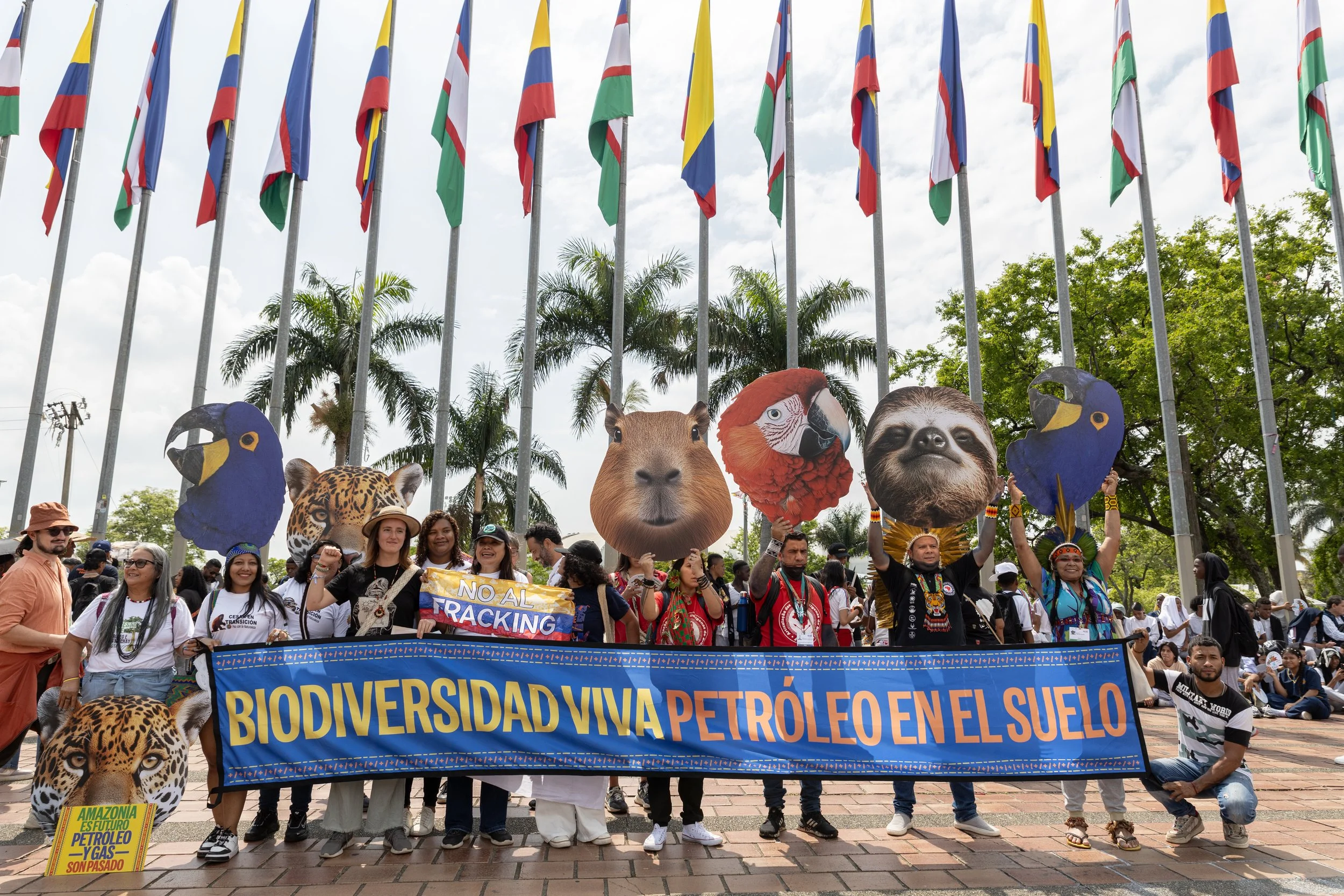
Mobilise in Santa Marta and Globally
Join us in Colombia between April 24–29 for the People’s Summit, Workers Summit, and Climate Justice Flotilla to ensure a strong presence. If you cannot attend, organise local distributed actions with a clear demand for a Treaty.
The Santa Marta Conference is our moment to shift global norms and demand the coordinated just transition the world urgently needs. Join us in calling for a Fossil Fuel Treaty.
What is the importance of a Fossil Fuel Treaty and the Santa Marta Conference?The Santa Marta Conference this April is a historic turning point in climate diplomacy. For three decades, global climate negotiations have focused on managing the symptoms of the crisis — emissions — while ignoring its root cause: the unchecked proliferation of oil, gas, and coal. Polluter influences have blocked progress, and this inaction has fueled a devastating polycrisis: climate breakdown driving unprecedented impacts on biodiversity, communities, lives and livelihoods; economic instability from volatile energy markets and debt entrapments; and conflicts over outdated, finite resources. These are not separate issues, they are interlinked fires, all sparked by fossil fuel dependence.
This moment offers a unique, decisive opportunity to strengthen multilateral cooperation by finally confronting these interconnected crises at their shared source. The Fossil Fuel Treaty is the essential tool to make this happen — a binding international framework to drive a global just transition to decentralized, accessible renewable energy for all by stopping the expansion of fossil fuels and managing an equitable phase-out. By championing the Treaty, leaders can move from empty pledges to enacting coordinated solutions. Accelerating a global just transition away from fossil fuels is the most urgent act of courage of our time, and a foundation for lasting peace, security, and the protection of all peoples and the planet we share.
Our dependence on fossil fuels funds imperialist wars while digging humanity's grave. The choice is clear: electrified nations that power justice and progress, or petrostates that weaponize markets and chain us into the past, increasing conflict and climate chaos.
Thirty years of climate negotiations have not addressed the poison in the system: fossil fuels. Santa Marta must be the summit that starts designing the cure: a binding global Treaty to transition away and phase them out.
We face not a single crisis, but a web of them — climate chaos, mass extinction, economic instability, and conflict — all fueled by the same source. The Fossil Fuel Treaty is the comprehensive solution that addresses them all at once.
The recent International Court of Justice Advisory Opinion changed the rules. New fossil fuel projects are not just dangerous, they risk breaking international law. Santa Marta is where governments must act on this new legal reality.
Real security in the 21st century doesn't come from controlling oil & gas fields, but from liberating every nation from the tyranny of fossil fuel dependency and debt entrapments. The Treaty is our shared security strategy.
A just transition is a debt owed, not charity given. A Treaty would ensure the fossil fuel giants and wealthy nations that profited from pollution pay their fair share to fund the just energy transition worldwide.
The global coordinated plan to transition away from fossil fuels already exists. A coalition of courageous countries is moving forward with the proposed Fossil Fuel Treaty. At Santa Marta, the world must decide: join this coalition of leadership, or be complicit in collapse.
Shifting from fossil fuels to decentralized renewables is not an economic burden — it is the defining strategic investment of our generation. The transition unlocks trillions in savings, drives innovation, and creates millions of stable, dignified jobs. The Treaty is the framework that makes this future accessible and equitable for all nations.
Every dollar spent on new fossil fuel infrastructure is a direct investment in future conflict, economic volatility, and climate disaster, as well as on a risky stranded asset. A Treaty would redirect that capital toward true security: energy independence, stable economies, and a livable planet for all.
The solutions have been clear for generations, spoken by those on the frontlines. Science has delivered its unambiguous verdict. The courts have now affirmed the law. Santa Marta presents the ultimate test: will our leaders finally find the courage to act?
The world can no longer afford fragmented promises. The Fossil Fuel Treaty is the unified, binding framework that strengthens international cooperation, turning our shared survival into a legally enforceable plan. At Santa Marta, leaders have the chance to support this key initiative to finally realise our shared mission: a transition to a just and fossil-free world.
Watch the Fossil Fuel Treaty's video on the road from Belém to Santa MartaBriefing for the Fossil Fuel Treaty’s Network on the First Conference on Transitioning Away from Fossil Fuels in April 2026, Santa Marta, Colombia.
Donate NowThe Governments of Colombia and the Netherlands have announced their plan to co-host the First International Conference for the Phase-Out of Fossil Fuels next year.
The landmark convening will take place on 28–29 April 2026, in the port city of Santa Marta, Colombia, which plays a significant role in coal exports. This will be followed by a second convening led by Pacific nation-states.
Its purpose is to advance international cooperation on transitioning away from fossil fuel extraction.
Helping ensure there is a significant presence of civil society, technical experts, trade unions and Global South governments at the conference will come with significant logistical costs. Can you help chip into our Conference fund to ensure there is a strong presence of those pushing for fast and fair transition to fossil free future in Santa Marta in April?
-
In the donation tool on this page you can select to donate in the following currencies:
Australian Dollar (AUD)
Brazilian Real (BRL)
British Pound Sterling (GBP)
Canadian Dollar (CAD)
Euros (EUR)
Indian Rupee (INR)
Mexican Peso (MXN)
New Zealand Dollar (NZD)
Swedish Krona (SEK)
Swiss Franc (CHF)
US Dollars (USD)However, if you’d like to donate in another currency please contact us at donations@fossilfueltreaty.org and we can likely help.
-
You can update your recurring donation at donorbox.org or by contacting us at donations@fossilfueltreaty.org
The Fossil Fuel Non-Proliferation Treaty Initiative is a fiscally sponsored project of Earth Island Institute, a 501(c)(3) nonprofit organization. All donations are tax deductible in the United States. Our federal tax identification number is 94-2889684. Your credit card statement will show the donation as a charge to Earth Island Institute (not our project name). Our mailing address is The Fossil Fuel Non-Proliferation Treaty Initiative, c/o Earth Island Institute, 2150 Allston Way, Suite 460, Berkeley, California, 94704. Earth Island is an environmental organization providing fiscal sponsorship to more than 75 projects. They are committed to sound fiscal management, accountability, and transparency. Earth Island is highly rated by the top charity rating services, and you can view their financial reports here.
View our impact report here.
Connect with us for live updates