
Best Practice Elements of Roadmaps for a Global Just Transition Away from Fossil Fuels
Guidance for countries developing national fossil fuel roadmaps
In recent years, significant attention has been devoted to advocating for, and supporting the development of, national-level roadmaps for the just transition from fossil fuels.
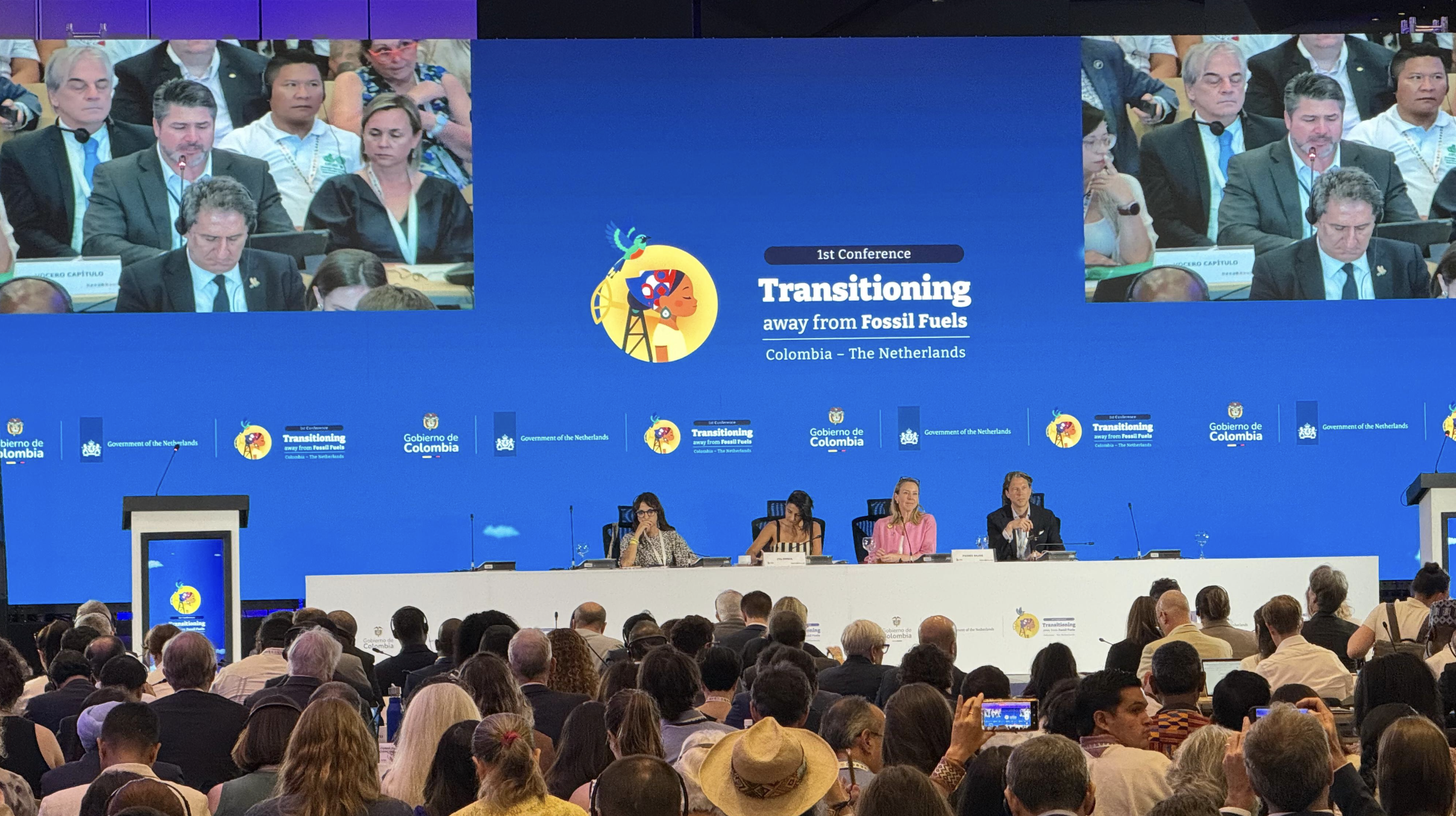
The First Conference on Transitioning Away from Fossil Fuels in Santa Marta in April 2026 recognised the importance of national roadmaps and announced a workstream supported by the NDC Partnership and the Science Panel on the Global Energy Transition to progress work on their development.
Likewise, initiatives such as the Beyond Oil and Gas Alliance have been providing technical support to countries to develop roadmaps.
It is clear that meeting the 1.5°C temperature goal, and enabling economic prosperity through reduced indebtedness, increased access to finance and removing dependence on fossil fuels, requires national-level action to transition away from fossil fuels. However, this national action must be situated within global benchmarks and governance frameworks to ensure that national roadmaps are sufficient to meet the intersecting challenges of our time.
This brief offers advice for countries developing a national roadmap. It draws on the outcomes of the First Conference, the advisory opinion of the International Court of Justice and the Fossil Fuel Treaty Initiative’s work with governments, Indigenous Peoples and civil society.
A credible roadmap needs to be ambitious and fair, and situated within a cooperative global effort - no country can transition alone.
Foundations for a credible roadmap
Roadmaps will necessarily need to look different in every country. However, every credible roadmap should be:
-
The International Court of Justice has recognised 1.5°C as the scientifically based consensus target under the Paris Agreement. Meeting this target requires:
an end to fossil fuel expansion;
a time-bound and equity-based plan for the managed phase-out of existing production with a phase out date and rate determined by what is required to reduce cumulative emissions from fossil fuels sufficiently to remain within the 1.5ºC target, and grounded in a country’s historical responsibility and capacity, in line with common but differentiated responsibilities and respective capabilities. Countries that have benefited the most from fossil fuels should move first and fastest.
-
A roadmap should set out new and additional policy measures, not merely restate or repackage existing policies. It should represent an advancement beyond current plans, towards a 1.5°C aligned pathway. The development of roadmaps must be a process of implementation, not documentation.
-
Situated within international cooperation, so that each roadmap contributes to a collective phase-out, helps address shared economic challenges and supports other countries to develop roadmaps of their own, with wealthy countries that have benefited the most from fossil fuels historically supporting and financing others to transition
-
A plan for economic transformation, rights protection and community and worker support, not just an energy transition: addressing fiscal systems, employment, trade, infrastructure and debt. Roadmaps should not selectively focus on one fuel and ignore others.
-
Designed with Indigenous Peoples participating as rights holders, respecting their right to self-determination and Free, Prior and Informed Consent (FPIC) in accordance with the United Nations Declaration on the Rights of Indigenous Peoples; and ensuring meaningful participation of Afro-descendant Peoples, traditional and local communities, workers, peasants, women, youth and other peoples and communities directly affected by the transition.
-
Roadmaps should rely on measures that deliver a concrete wind down of fossil fuel production and real, permanent and verifiable reductions in emissions. Qualifiers such as “unabated” production or “inefficient” subsidies have no agreed international definition, and can allow production to continue while giving the appearance of progress. Roadmaps should not justify continued production on the basis of approaches whose emissions reductions are uncertain, impermanent or not demonstrated at scale. The IPCC has found that ‘Currently, global rates of CCS deployment are far below those in modelled pathways limiting global warming to 1.5°C to 2°C’. Offsets and removals based on forests and land are exposed to reversal, and solar geoengineering would not reduce emissions at all while risking dangerous environmental impacts.
Possible elements of a roadmap
Building on the foundations above, countries can select from the elements below those that best enable them to meet their goals. Click on dropdown categories to see more detailed guidelines.
Not every element will apply to every country, and priorities will differ between producer and non-producer countries, and between developed and developing countries.
The elements have been drawn from a range of sources, including the Co-Host’s Report of the First Conference on Transitioning Away from Fossil Fuels, recommendations on addressing fossil fuels in NDCs and the Fossil Fuel Treaty Initiative’s Policymakers’ Toolkit for a Just Transition from Fossil Fuels.
-
An end to new exploration and extraction - for producer countries, at a minimum a commitment to issue no new exploration or extraction licences, ideally alongside cancelling or declining to renew licences within defined reserves.
A phase-out schedule for existing production - for producer countries, a clear end date for each fuel, in line with national realities and the country’s fair share, with interim milestones along the way in line with the 1.5ºC limit. Developed producer countries should set dates to phase out production as quickly as possible, in recognition that countries with less capacity or greater dependence on fossil fuel production may need more time and support to transition.
A commitment not to produce - countries that do not currently produce fossil fuels can commit not to explore for or extract them.
Plans for state-owned and private producers - transition plans for national oil companies and other state-owned producers, and regulation of companies headquartered in the country that produce fossil fuels abroad.
Responsible closure - plans for decommissioning infrastructure and closing mines and fields, including who is liable, how sites will be remediated and how this will be financed.
-
Support to be provided - developed countries should set out the finance, technology and capacity-building support they will provide, consistent with their obligations under the Paris Agreement and other treaty and customary international law obligations.
Support needed - developing countries can set out the support they need to deliver their roadmap, including direct, accessible and non-debt-creating finance, debt relief and technology, and which elements are conditional on that support.
Cooperation needs - identifying where trade dependence, investment treaties (including exposure to investor-state dispute settlement) or the actions of trading partners limit what the country can do alone.
Cooperation with other countries - identifying the initiatives and partnerships the country will join or lead, such as producer-consumer arrangements, collective action on debt, regional industrial and energy cooperation, and sharing experience with other countries developing roadmaps.
Advocating for a global framework - identifying the need for a global framework to articulate and clarify obligations with respect to fossil fuels, establish mechanisms to enable the transition, and provide benchmarks against which national roadmaps can be measured, such as a Fossil Fuel Treaty. Roadmaps could include commitments to participate in the Bloc of Nations that have been developing a Fossil Fuel Treaty.
-
Clean and affordable energy - plans to replace fossil fuels with renewable energy, efficiency and electrification, including investment in the grids and storage needed, while expanding reliable and affordable energy access for underserved communities and supporting community-owned energy, energy sovereignty and energy democracy. Electrification commitments must be based on non-fossil fuel-based electricity.
Non-combustion uses - a commitment not to expand petrochemical and plastics demand for fossil fuels, which would otherwise delay the phase-out of production.
Avoiding new extractive dependence - safeguards so that critical minerals and renewable energy projects do not reproduce the harms of fossil fuel extraction.
-
Economic diversification - a plan for alternative sources of public revenue, employment and value creation, including through industrial policy and local and clean energy value chains, while avoiding new forms of extractive and low-value-added dependence.
Subsidy reform - an inventory of fossil fuel subsidies, including tax breaks, and a plan to phase them out and redirect the funds, with measures to protect low-income households. Inventories could be completed through membership or with guidance from the Coalition on Phasing Out Fossil Fuel Incentives Including Subsidies (COFFIS).
Finance - an investment plan for the transition, including dedicated just transition funds.
Debt and the cost of capital - identifying where debt burdens and high costs of capital constrain the transition, so that these can be addressed with international partners.
-
Territorial just transition plans - region-specific plans for fossil fuel-dependent areas, co-designed with workers, communities, governments and the private sector, linking labour transition to new industries, mine and field closure and environmental restoration.
Social dialogue - institutionalised mechanisms at national and subnational levels for workers, unions, employers and communities to shape decisions, in line with the ILO Guidelines for a just transition, including clear communication with workers and communities in transition regions.
Social protection and decent work - labour reconversion programmes, green skills training, income support and pathways to decent employment, with dedicated funding.
-
Indigenous Peoples’ rights - “including their right to free, prior and informed consent and the importance of ensuring that all just transition pathways respect, protect and promote the distinct, collective and internationally recognized rights of Indigenous Peoples, including the right to self-determination, and acknowledge the specific rights and protections for Indigenous Peoples in Voluntary Isolation and Initial Contact, in accordance with relevant international human rights instruments and principles;”
Indigenous-led territorial transition plans – ensure Indigenous Peoples’ self-determination over territorial and environmental planning, respecting their own governance systems and guaranteeing their Free, Prior and Informed Consent (FPIC) in the design and implementation of energy transition activities and projects, including mine and fossil fuel infrastructure closure and ecosystem restoration.
Inclusive participation - meaningful roles for frontline communities, women, children and youth, Afro-descendant communities, peasant communities and subnational governments, drawing on local and community knowledge alongside scientific evidence, and protection for environmental defenders.
-
Reporting on production - public reporting of fossil fuel reserves, resources and infrastructure, and of historical, current and projected production and associated emissions, which could feed into a Global Registry of Fossil Fuels.
Integration with NDCs - reflecting roadmap commitments in NDCs and long-term strategies, and embedding them in national legislation.
Review - regular, independent review against interim milestones, with the roadmap updated as circumstances change.
-
Measures to reduce the social license and impact the activities of the fossil fuel industry - including price and tax measures, regulation of the quality and content of fossil fuel products, banning and restricting fossil fuel advertising and sponsorship, measures to combat misinformation and greenwashing, education and public awareness building.
Placing limits on the influence of the fossil fuel industry on policymaking – measures to limit the influence of the fossil fuel industry and potential conflicts of interest in policy-making, including measures to protect policy-making from commercial and other vested interests (similar to Article 5.3 of the Framework Convention on Tobacco Control), including measures such as limits, restrictions and transparency measures on fossil fuel industry lobbying and donations.
Banning and restricting fossil fuel advertising, sponsorships – roadmaps can scale policies used by some jurisdictions to limit advertising, sponsorship and misinformation scaled by the fossil fuel industry to scale their operations and greenwash the impact of coal, oil and gas
-
Address all fossil fuels – avoid framing fossil gas as a ‘natural gas’ or low-carbon fuel option with long-term viability and explicitly include a phase out timeline for gas production and exports, including LNG, alongside coal and oil.
Avoid justification of fossil fuel production using speculative future technologies – including avoiding roadmap inclusion of carbon capture and storage, carbon offsets, speculative removals, nuclear energy expansion, large-scale hydropower projects, ammonia and hydrogen co-firing, large-scale solid biomass and liquid biofuels, all forms of geo-engineering as justification for ongoing coal, oil and gas production. These uncertain, impermanent or unscalable approaches must not divert resources from sustainable renewable-based solutions or perpetuate extractive and unequal energy systems.
National roadmaps are essential. However, they will not add up to a 1.5°C-aligned and equitable transition on their own. As the report of the First Conference on the Transition Away from Fossil Fuels recognises, ‘many transition barriers cannot be overcome through national action alone’.
A global framework on the just transition from fossil fuels, such as a Fossil Fuel Treaty, could allow countries to agree to:
Benchmarks against which progress can be measured. For example, parties would commit to:
Ending expansion - no new fossil fuel extraction projects, consistent with the scientific consensus that existing fields and mines already exceed the 1.5°C carbon budget;
An equitable phase-out of existing production - pathways set by the 1.5°C limit and differentiated by historical responsibility, capacity and national circumstances, with wealthier and less-dependent producers moving first and fastest;
Safeguards - ensuring the transition does not create new harms, including through green extractivism, and protecting workers and affected communities.
Mechanisms to end fossil fuel dependence and enable a just transition. For example, a Treaty could establish the cooperative machinery that makes transition achievable and supports alternative development pathways and energy access:
Finance - obligations on developed country Parties to provide concessional finance, as well as generating transition finance through mechanisms such as levies on fossil fuel production and exports and/or sovereign wealth funds, and cooperative arrangements such as a buyers-sellers club that delivers economic benefits to participating States.
Debt - a debt resolution facility providing restructuring support and relief tied to transition, addressing the fiscal distress that locks many producer countries into continued extraction.
Legal barriers - coordinated action on ISDS and investment treaties, including mutual commitments among Parties to remove fossil fuel investment protections between themselves and shared approaches to managing claims.
Transparency, compliance and institutional arrangements. To help monitor, guide and provide a clearinghouse for sharing of lessons and technical knowledge.
Many of these mechanisms are already being proposed. However, if developed in isolation, they risk becoming a fragmented patchwork. These are the functions an international framework such as a Fossil Fuel Treaty could provide, housing them in one coherent architecture. The Second Conference on Transitioning Away from Fossil Fuels in Tuvalu is an important opportunity to take this forward, by agreeing not only what national roadmaps should contain, but what countries willing to move first could do together to deliver them.