
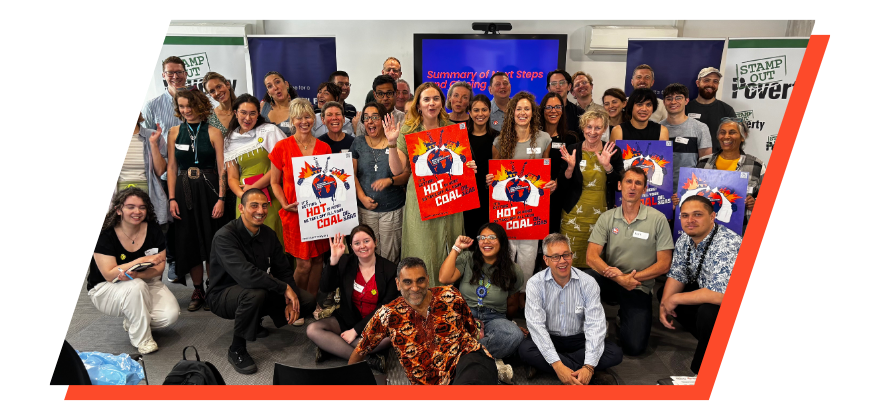
LONDON CLIMATE ACTION WEEK 2026
London Climate Action Week: a critical moment to build momentum for a fossil fuel phase outAs fossil fuel expansion accelerates and climate progress stalls, Climate Weeks like London’s are essential to build pressure between COPs and turn bold ideas into real commitments. This London Climate Action Week, the Fossil Fuel Treaty Initiative network will gather decision makers, climate leaders, activists and artists to call for international cooperation to end the fossil fuel era.

The Fossil Fuel Treaty: an opportunity to turn momentum into actionIn the face of rising regressive climate politics and narratives, the Fossil Fuel Treaty Initiative offers a crucial response — and global momentum is growing behind it. It is the clear plan the world needs to phase out fossil fuels through an equitable transition. Led by frontline communities and funded by those most responsible. It’s not a distant goal. The shift has already begun.

-
2024 was the hottest year on record, and the first to exceed the 1.5°C threshold set by the Paris Agreement. This stark milestone signals an urgent truth: the window to prevent the most catastrophic impacts of climate collapse is rapidly closing, so denying the climate crisis is not an option.
This is not only a global phenomena: in the UK Spring 2025 has “broken historical climate records”, and has been the warmest and sunniest year since records began being collated. It is also the driest Spring since 1893, according to the country’s Environment Agency. The UK Met Office has warned that the country has a 50:50 chance of seeing temperatures reaching above 40°C in the next 12 years, as it did for the first time on record in 2022, and “temperatures several degrees higher than we saw in July 2022 are possible in today’s climate.” It also made clear that this is happening “because our climate continues to warm”.
But there is hope. Some governments are beginning to understand what a real energy transition means: ending fossil fuel dependence, not just shifting suppliers. They’re rethinking energy security at its root and taking bold steps to phase out oil, gas, and coal. Protecting our planet and our lives means breaking free from fossil fuels and ending the neo-colonial scramble for resources in the Global South. The door is open — now we must push it wide.
What leaders choose to do between now and 2030 will define our collective future and climate, and the Fossil Fuel Treaty Initiative offers a clear plan to manage a global transition away from fossil fuels. It is the missing tool to help the world shift from dangerous dependence on fossil fuel-producing countries by advancing a just and coordinated phaseout.
17 countries — including fossil fuel producers like Colombia and Timor-Leste, and most recently joined by Pakistan — are now engaged in discussions around the proposed Treaty. Together, they are exploring multilateral cooperation under three core pillars:
Non-proliferation: Stop new coal, oil, and gas projects.
Fair phase-out: Gradually reduce existing production based on each country’s historical responsibility and economic dependence.
Just transition: Ensure support and financing so that workers, communities, and countries are not left behind, avoiding the repetition of colonial and extractivist models.
The Fossil Fuel Treaty initiative is supported by a growing movement which includes former UN Secretary General Ban Ki-moon, the WHO, the European Parliament, over 4000 civil society organisations, over 3,000+ scientists and academics, 101 Nobel laureates, the hundreds of health professionals, a Vatican Cardinal and thousands of religious institutions, a growing number of grassroots organisations, 11 Amazonian Indigenous nations, thousands of youth activists, 130 cities and subnational governments around the world including UK cities such as London, Manchester, Birmingham, Edinburgh and Glasgow, more than 600 Parliamentarians across the world and a growing number of businesses.
-
London has taken new strides as a beacon of climate leadership.Under Mayor Sadiq Khan, the city has taken bold steps to phase out fossil fuels, invest in clean energy, and prioritize environmental justice. Since 2022, his endorsement of the call for the Fossil Fuel Non-Proliferation Treaty has signaled a strong commitment to global cooperation and a just transition that safeguards both people and the planet. Now, as the newly appointed Special Envoy for Fossil Free Cities for the Fossil Fuel Treaty Initiative, Mayor Khan will help accelerate the global shift away from fossil fuels and elevate the voice of cities at the forefront of the climate fight.
London Climate Action Week is a critical moment to build momentum for a fossil fuel phase out. The world cannot wait for COPs each November; Climate Weeks are essential to keep up the pressure, grow the movement, and push for real commitments between summits.
And in the UK, a growing number of diverse voices are already calling for a Fossil Fuel Treaty:
UNISON — the country’s largest union — as well as the University and College Union (UC) and the Bakers and Food Workers Union (BFAWU) are firmly backing the call for a national energy transition. A just and properly financed shift from fossil fuels to clean energy isn’t optional; it’s essential. Their support reinforces the urgent demand for a fair transition that protects workers and communities as the UK moves away from oil and gas.
Peaceful demonstrators swept across the UK, urging the government to commit to ending fossil fuels instead of criminalising people protecting our planet. While the Fossil Fuel Treaty Initiative was not involved in organising these actions, we stand in solidarity with people’s right to peaceful protest who are speaking out in this moment of crisis and catalysing change.
During a concert on World Environmental Day, Greater Manchester and Massive Attack also joined the call for a Fossil Fuel Treaty showing momentum keeps building in the UK with cities and artists coming together for a concrete solution to end fossil fuel destruction.
The Labour Government’s landmark pledge to end new offshore oil and gas licences is internationally important. This must not be rolled back in the face of pressure from President Trump’s anti-climate, ‘drill baby drill’ agenda and mobilisation of the far right behind the fossil fuel industry. This means that the UK government should not greenlight projects like Rosebank. This new field won’t lower fuel bills or boost energy supply - most of its oil will be exported - and UK taxpayers will cover most of the cost of developing it. Given the amount of emissions it will cause - more than the annual emissions of the world’s 28 lowest-income countries - and its incompatibility with the UK’s commitments to play its part in preventing catastrophic climate change, the case for rejecting it and all future oil and gas developments could not be clearer.
The Government’s initiative to launch a Global Clean Power Alliance focused on scaling up renewable energy could play a significant role, but must also address fossil fuel phase out to be a real bridge to a safer world.
But the UK must also take responsibility as a major financial hub and one of the world’s most influential nations — a member of the G7, G20, UN Security Council, and NATO and the world’s fifth largest historical emitter, the UK must support developing countries through scaled up finance and technology transfer and as a champion of a planned global fossil fuel phase out that leaves no-one behind.
As a global power and major financial hub, the UK must act to regulate the industry. UK banks have poured over $100 billion into fossil fuel “carbon bombs”, undermining the country’s climate credibility.
To align with its climate commitments and regain the trust of the international community, the UK must actively resist the regressive fossil fuel agenda gaining ground in the US under Trump. This means ending fossil fuel financing, supporting a just global transition and standing with countries working to advance a Fossil Fuel Non-Proliferation Treaty.
-
The UK helped ignite the Industrial Revolution—now it must help end the fossil fuel era.
Ending the era of fossil fuels by moving to society and an economy based on renewable energy and energy efficiency is critical for energy security will have major economic benefits for households and the UK Government’s own budget - according to the UK Government’s own figures, the cost of energy subsidies to mitigate the spike in gas prices caused by Russia’s invasion of Ukraine was £62.5bn between 2022-24 (and this doesn’t include the indirect costs to households caused by rising food and other essential goods). It is clear real UK energy independence will only come once the country ends its reliance on fossil fuels for power.
At London Climate Action Week, a growing global movement is calling to launch negotiations for a Fossil Fuel Non-Proliferation Treaty by 2026.
The Treaty offers a clear plan to phase out fossil fuels through an equitable transition—led by frontline communities and funded by those most responsible. It’s not a distant goal. The shift has already begun. Now it’s time to make it global, binding, and fair.
The Fossil Fuel Treaty Initiative Events during London Climate Action Week 2026-
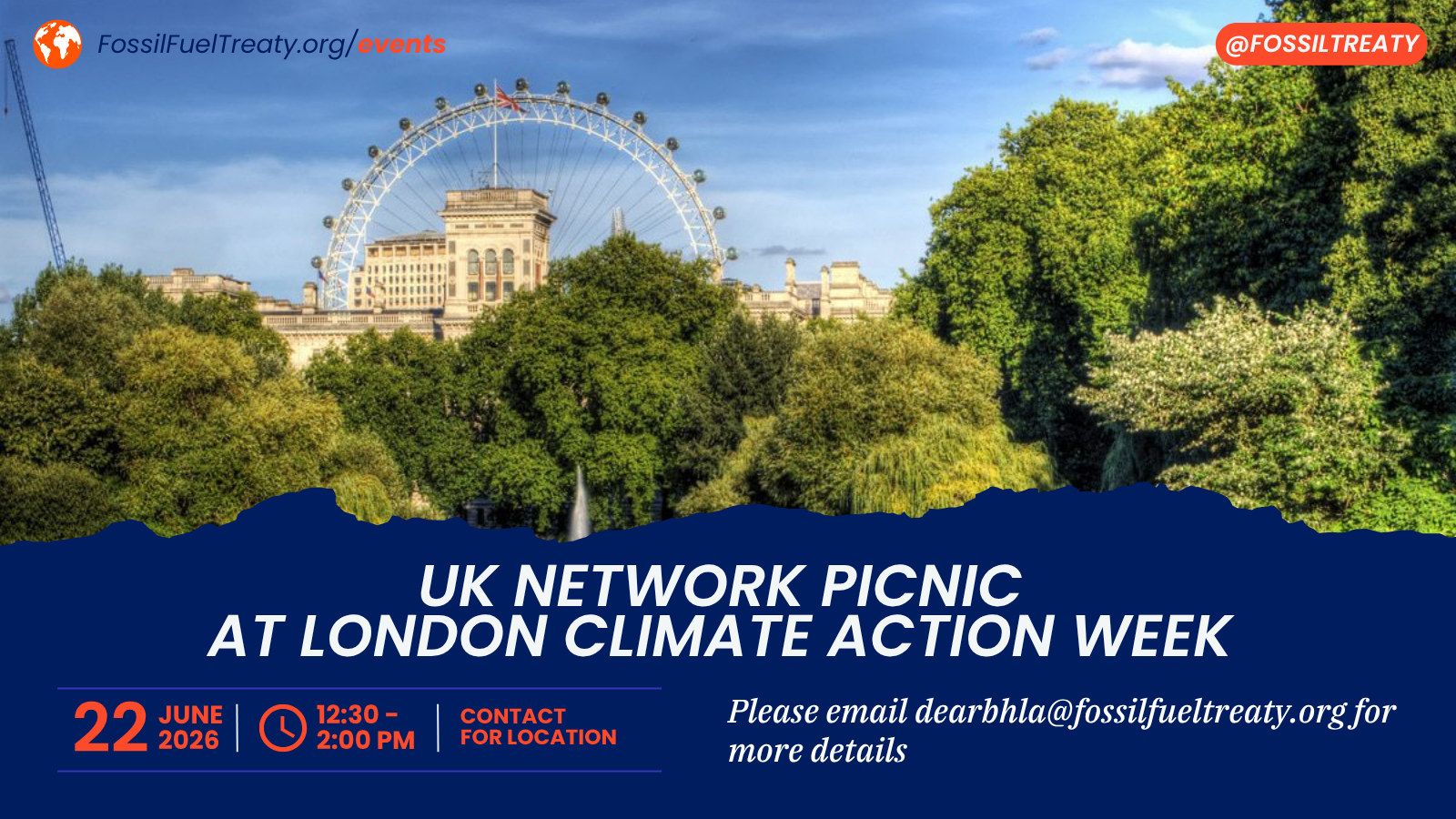
UK Network Picnic
Date: Monday, June 22
Time: 12:30 - 2:00 BST
Location: Private location, contact dearbhla@fossilfueltreaty.org for more detailsJoin the Fossil Fuel Treaty Initiative for a United Kingdom network meeting! This meeting will be a picnic during London Climate Action Week 2026. For more information, please contact Dearbhla Richardson, the Europe Campaigner for the Fossil Fuel Treaty, at dearbhla@fossilfueltreaty.org.
-
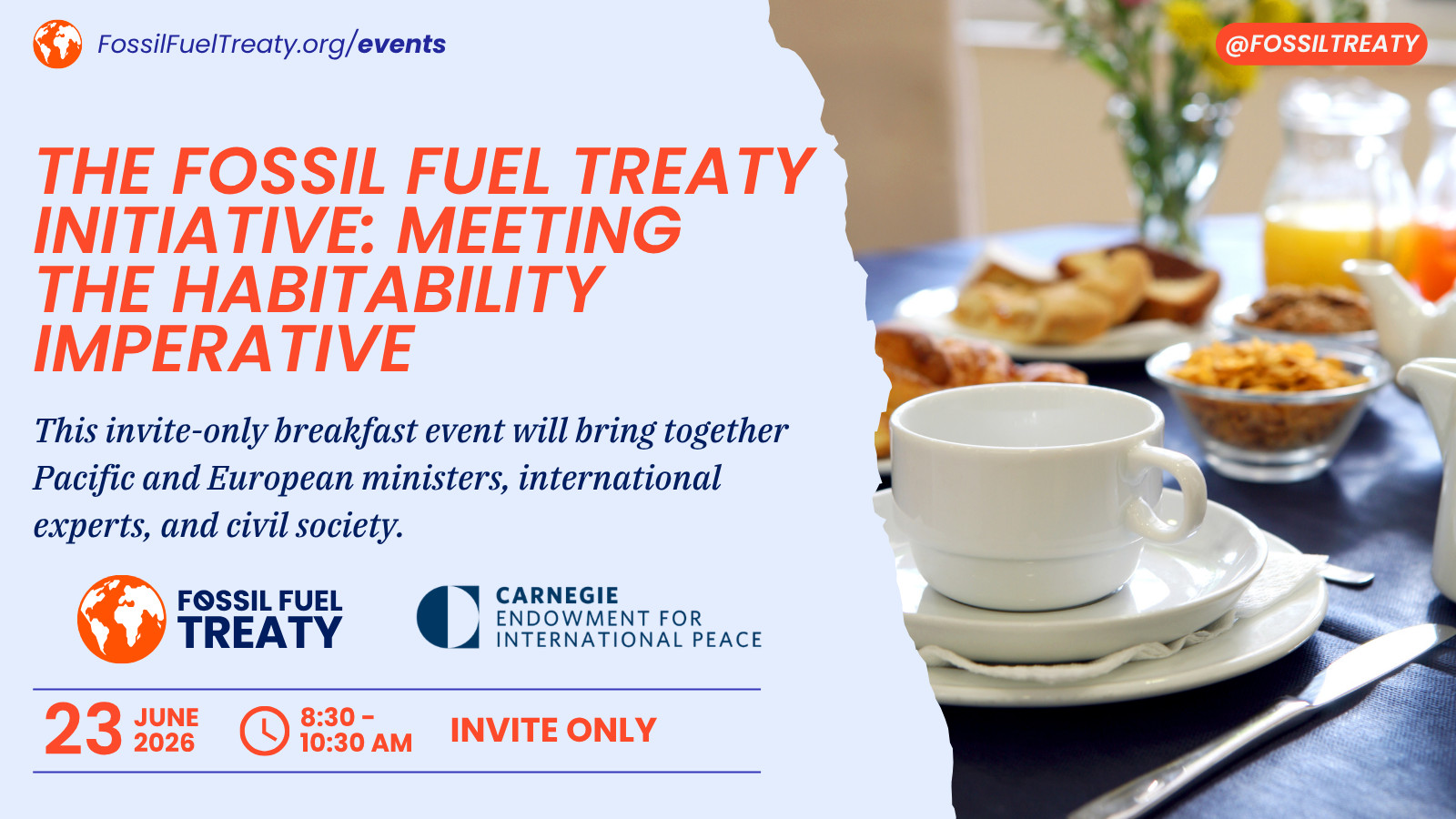
The Fossil Fuel Treaty Initiative: Meeting the Habitability Imperative
Date: Tuesday, June 23
Time: 8:30 - 10:30 AM
Location: Private LocationThis invite-only breakfast event is hosted by the Carnegie Endowment for International Peace and the Fossil Fuel Treaty Initiative.
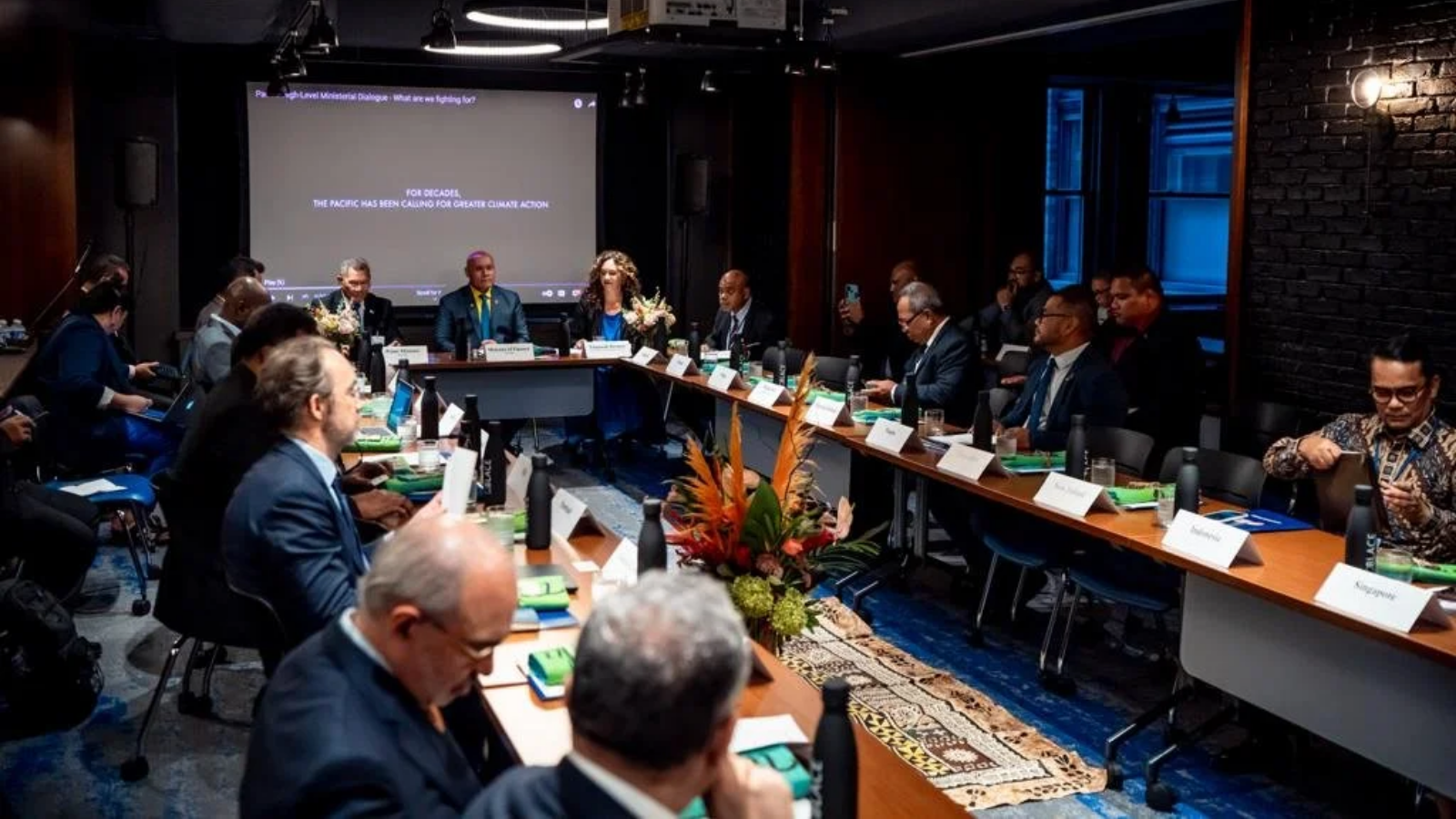
This event will bring together Pacific and European ministers, international experts, and civil society to connect the dots between phasing out fossil fuel production and safeguarding our shared humanity, celebrate the momentum from the recent Santa Marta convening and a inform what must happen next, ahead of the second diplomatic conference hosted by the governments of Tuvalu and Ireland in 2027.
-
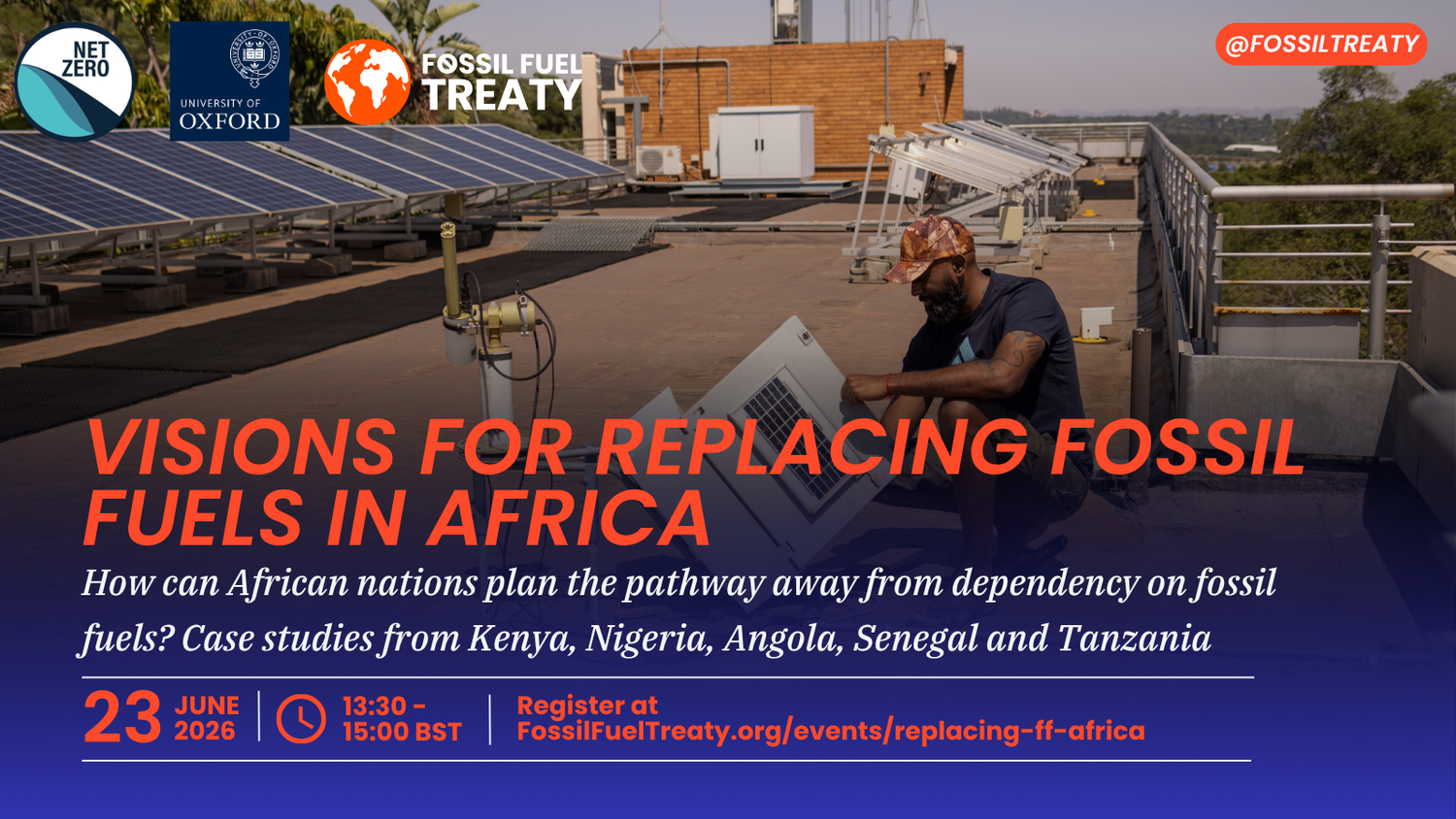
Visions for Replacing Fossil Fuels in Africa
Date: Tuesday, June 23
Time: 13:30 - 15:00 BST
Location: VirtualPlease join us on 23 June at 13.30-15.00 BST for a launch webinar for the project‘Visions for Replacing Fossil Fuel Revenues in Africa’.
The webinar will feature researchers from Angola, Tanzania, Senegal, Kenya and Nigeria - as they share preliminary insights on potential pathways to replace fossil fuel revenues and plan a managed transition away from fossil fuels - underpinned by national and international cooperation.
-
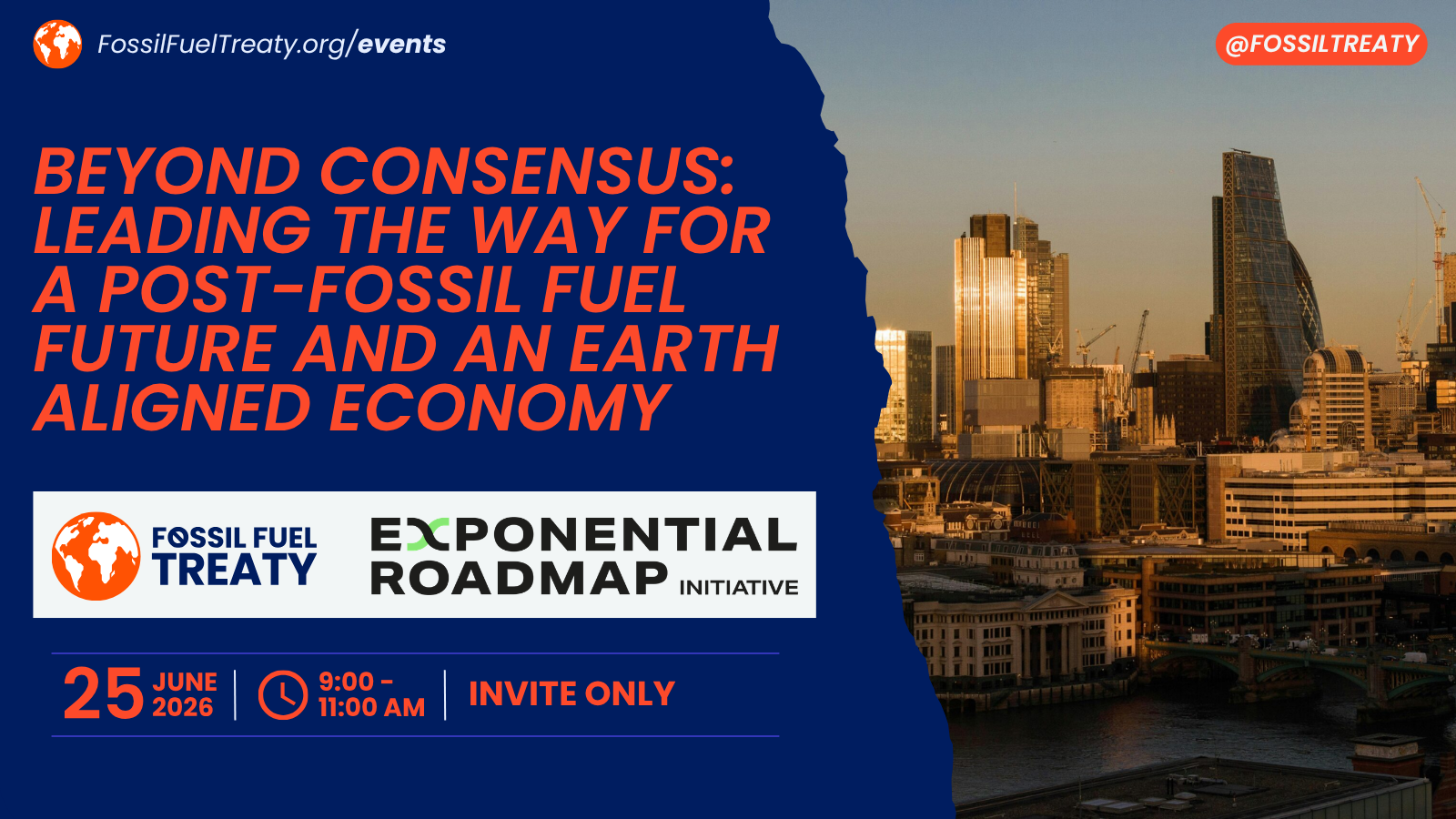
Beyond Consensus: Leading the way for a post-fossil fuel future and an earth aligned economy
Date: Thursday, June 25
Time: 9:00 - 11:00 AM
Co-hosts: Exponential Roadmap Initiative, Fossil Fuel Treaty
Location: Invite onlyBuilding on the Santa Marta process, where private sector engagement was still emerging, this session aims to support the formation of a more coherent and coordinated business perspective on fossil fuel phase-out and transition pathways, ensuring stronger private sector input into the Tuvalu process and a clearer articulation of what is needed to accelerate a managed fossil fuel phase-out while maintaining competitiveness and resilience.
The intent is to clarify constraints, identify enabling conditions, and align around a shared economic framing of decoupled growth and emissions — the “Crocodile Economy”. A key outcome will also be to align on the role the private sector can play in the success of the 2nd conference.
Partner Events during London Climate Action Week 2026-
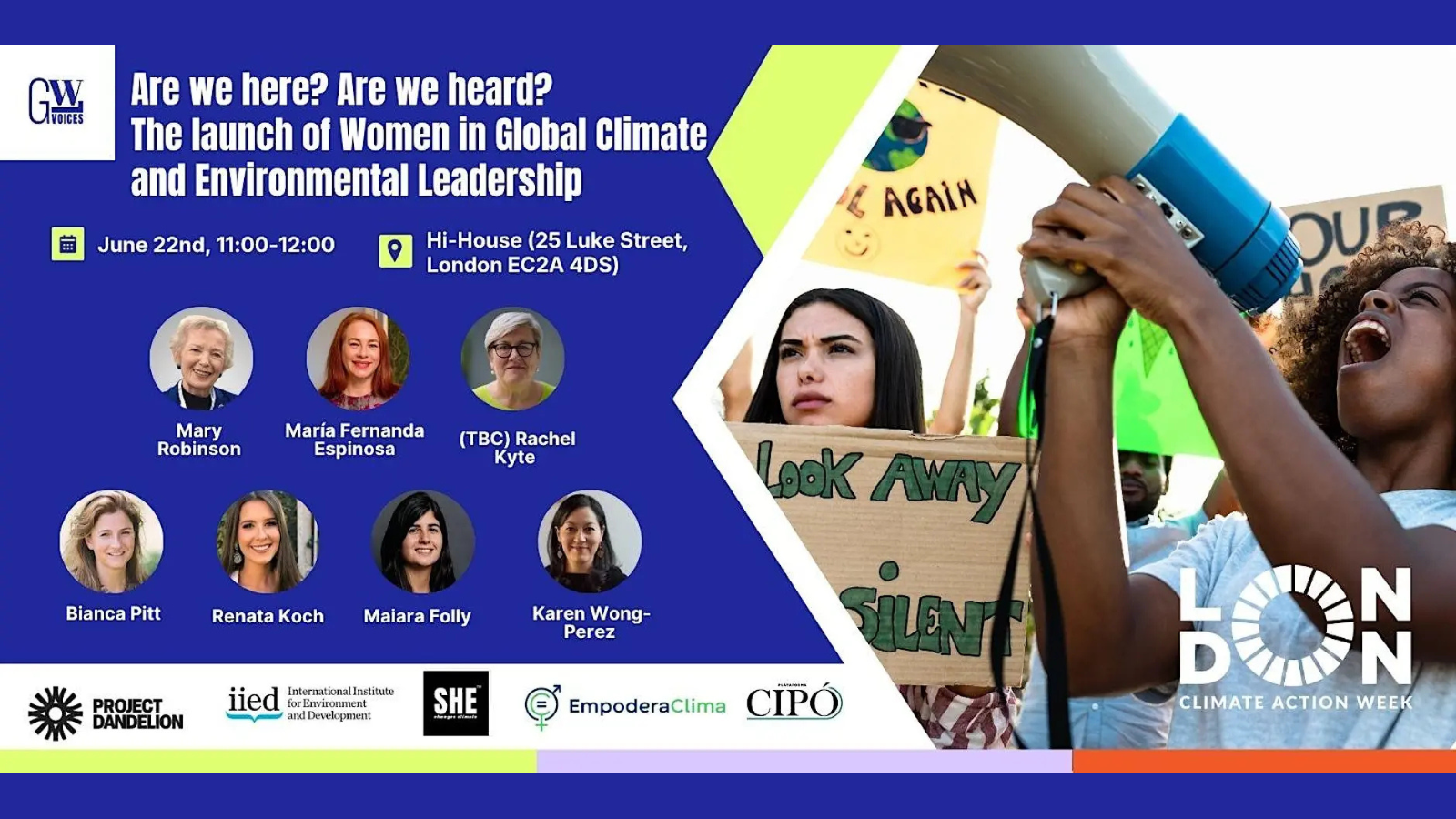
Launch of Women in Global Climate and Environmental Leadership
Date: Monday, June 22
Time: 11 AM - 12 PM
Location: 25 Luke St, London, EnglandHigh-Level launch of the report at London Climate Action Week 2026 followed by a panel discussion
Despite their central role in community resilience, adaptation, and environmental stewardship, women remain markedly underrepresented in the highest levels of climate decision-making. GWL Voices’ new Spotlight report on Women in Global Climate and Environmental Leadership presents new figures spanning over 30 years of data on leadership and participation at seven key multilateral climate and environmental institutions, including the three Rio Conventions.
-

Women Leaders Protecting People and Planet: Stories, Solutions and Solidarity
Date: Tuesday, June 23
Time: 3:30 PM - 6:00 PM
Location: Rights and Nature Hub, The Stables, MYO King’s Cross, 2 Trematon Walk, London N1 9FBJoin us for an inspiring event with frontline Indigenous and Afro-descendant women leaders and global advocates from the Americas as they share stories, strategies and solutions about the global biodiversity and climate crises by reforesting our hearts and minds.
Hosted by If Not Us Then Who?, Rainforest Action Network (RAN), Amazon Watch, Women’s Earth and Climate Action Network (WECAN)
-

A World Worth Choosing - Building a Holistic Vision for a Safe and Just Future
Date: Wednesday, June 24
Time: 10:00 AM - 12:00 PM
Location: Friends House, London, United KingdomThe sustainability movement faces a pivotal moment. Climate, biodiversity, poverty, and inequality are being treated as competing priorities — when in truth, they are different expressions of the same systemic failure.
This session challenges that false trade-off. Bringing together leading scientists, advocates, and communicators, we will explore what a genuinely just world on a safe planet looks like — and why it is not a sacrifice, but the most compelling vision for prosperity, resilience, and belonging in the 21st century.
-
Carbon Tracker & Confleunce Philanthropy at LCAW 2026
Date: Wednesday, June 24
Time: 5 PM - 6:30 PM
Location: LABS 90 High Holborn London, EnglandFrom Santa Marta to Crisis in the Middle East: Fossil Fuel Phaseout, Energy Transition and Implications for Investors
Join us during London Climate Action Week for a timely discussion on the global shift away from fossil fuels – and what it means for investors navigating an increasingly volatile energy landscape.
The session will explore how shifting demand and global policy alignment are reshaping fossil fuel markets and redefining risk, returns and capital allocation.
-
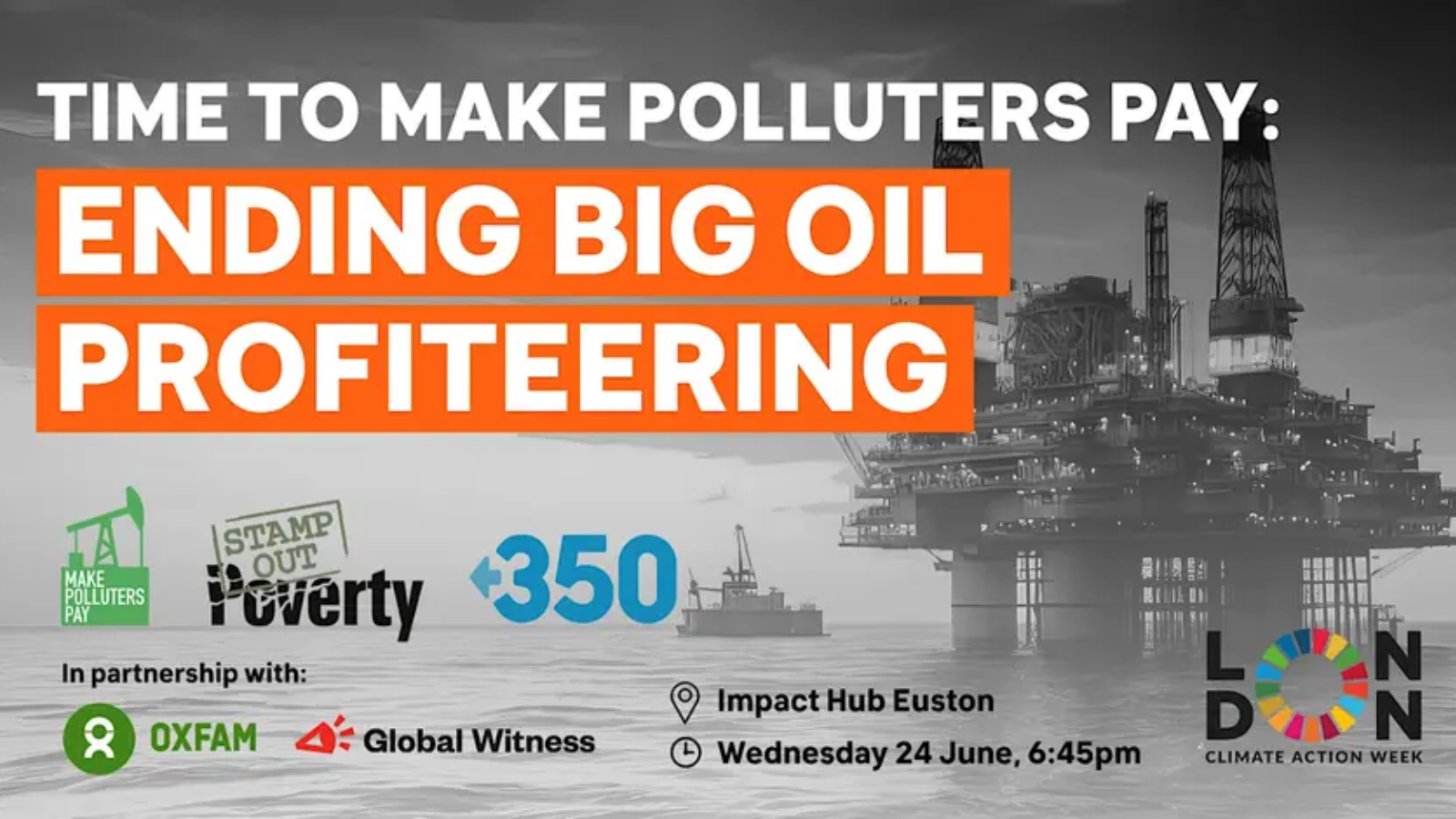
Time to Make Polluters Pay: Ending Big Oil Profiteering
Date: Wednesday, 24 June
Time: Doors open at 6:45 PM
Location: Impact Hub Euston, 1 triton Square, London NW1 3DX
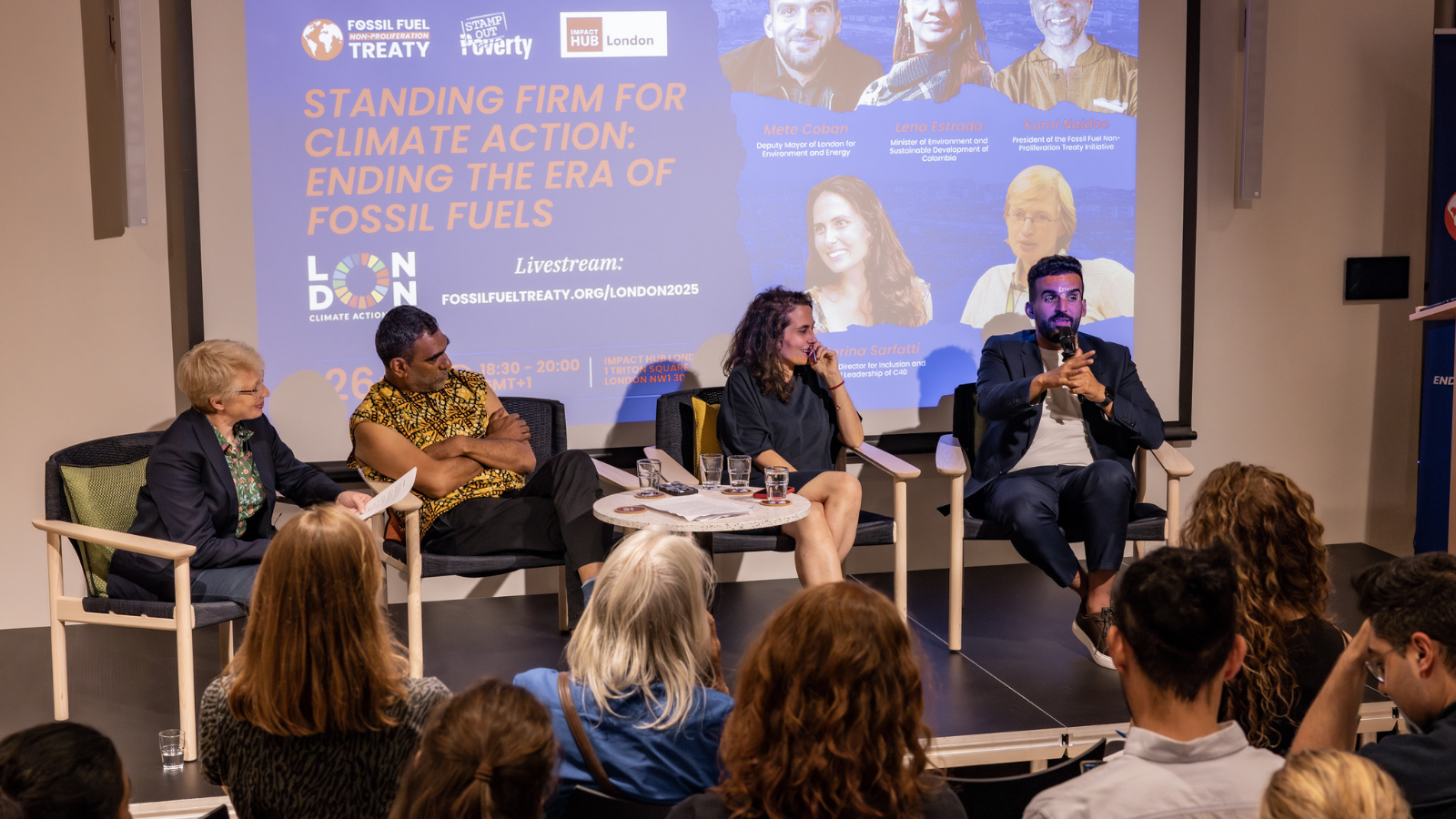
Join journalists, campaigners & frontline voices to explore shifting climate narratives, legal breakthroughs & making polluters pay.The Make Polluters Pay agenda is moving rapidly into the mainstream, and London Climate Action Week is a key moment to bring the movement together.
Organised by Stamp Out Poverty and 350.org for the Make Polluters Pay Coalition for London Climate Action Week.
With thanks to partners Oxfam and Global Witness.
-

Double Launch Reception
Date: Thursday, 25 June
Time: 15:30 - 18:00 BST
Location: County Hall, London, UKYou are cordially invited to an exclusive double launch reception during London Climate Action Week, where we will unveil two ambitious and interlinked initiatives addressing two defining challenges of our time: the future of public discourse and the transition away from fossil fuels.
With access to more than 40 million users from day one, W combines global reach with a new focus on trust, transparency and meaningful dialogue at a time when social media is increasingly shaped by AI-generated content and disinformation.
Join the public beta launch of W and receive a personal invitation to become one of the first users.
Momentum for a Fossil Fuel Treaty is building in the UKAcross the country, a growing number of diverse voices are already calling for a Fossil Fuel Treaty. From major cities like London and Manchester, to artists like Massive Attack and trade unions like Unison, powerful UK voices are calling on their government to actively resist the regressive fossil fuel agenda gaining ground in the US under Trump by standing with countries working to advance a Fossil Fuel Treaty Initiative.

London has emerged as a beacon of climate leadership. In 2022, the city endorsed the call for a Fossil Fuel Treaty and since then, Mayor Sadiq Khan and Deputy Mayor Mete Coban have only strengthened their support!Media Briefings and Resources for London Climate Action WeekShort briefing notes that can help inform governments, cities and other decision-makers about the case for a Fossil Fuel Treaty Initiative. Want to organise for a member of the Treaty Support Team to join a briefing? Contact campaign@fossilfueltreaty.org
-
![]()
The Double Dividend: How Reducing Military Spending Can Finance a Just Transition
Katrin Geyer and Genevieve Riccoboni, 2026
-
![]()
Spillover Effects: The Fossil Fuel Debt Trap in the Global South
Nasrallah, A.; Rodriguez, C.; Fouad, H.; Elhatimi, I.; Rambarran, J.; Mohan, P.; Kadirgamar, N. & Sawas, A. (2026)
-
![]()
Developing an International Regime to Advance the Transition Away from Fossil Fuels
Fossil Fuel Treaty (2026)
Read report in
English | Spanish | Portuguese -
![]()
Gender, Debt and Fossil Fuels: A Mapping of Key Insights from the African Continent
Bemnet Agata and Dr. Amiera Sawas (2026)
-
![]()
G20 Carbon Bombs: Threat of Fossil Fuel Reserves vs. Opportunity for a Just Transition
Fossil Fuel Treaty Initiative with data from the Global Registry of Fossil Fuels (2025)
-
![]()
-
![]()
Fossil Fuel Commitments in Nationally Determined Contributions
Sergio Díaz, Legal Strategy Director at Fossil Fuel Treaty (2025)
-
![]()
Debt Justice and Financing the Just Global Energy Transition: International Cooperation on the Climate-Debt Crisis and the Role of a Treaty
Jwala Rambarran and Dr. Amiera Sawas (2025)
-
![]()
-
![]()
Transitioning Away from Fossil Fuels to Curb Air Pollution Health Harms
Rachel Ruback, Lucas Snaije (2025)
-
![]()
Exporting Harm: The Climate Toll of Australia’s Fossil Fuel Expansion
Fossil Fuel Treaty Initiative (2025)
-
![]()
We Must Stop Subsidising Fossil Fuels and Tax them Instead: A Shipping Levy is the Best Way to get Serious this Year
Dr. Christiaan De Beukelaer, University of Melbourne (2025)
-
![]()
If It's Not Global, It's Not Just: How a Fossil Fuel Non-Proliferation Treaty can Accelerate Finance for a Global Just Transition
Dr. Amiera Sawas, Rebecca Brynes, Mia Partridge (2024)
-
![]()
Financing a Fair and Fast Energy Transition
Fossil Fuel Treaty, 2024
-
![]()
What It Means For A Country To Join The Bloc Of Countries Participating In Discussions On A Fossil Fuel Treaty
Fossil Fuel Treaty, 2025
-
![]()
How a Treaty Can Catalyse Just Transition Finance
Dr. Amiera Sawas (2025)
-
![]()
UNCOMMON WEALTH: Fossil Fuel Expansion in the Commonwealth Dominated by Three Wealthy Countries
Fossil Fuel Treaty Initiative, prepared with data from the Global Registry of Fossil Fuels, housed by Carbon Tracker Initiative. Data and analysis prepared by Johnny West (2024)
-
![]()
Proposed Fossil Fuel Treaty Initiative: A Seat at the Table (One-Pager)
-
![]()
Cities for a Fossil Free Future: From Enhancing City Diplomacy to Decarbonising Key Sectors
Lucas Snaije (2024)
-
![]()
Fossil Fuel Free Cities Toolkit
Lucas Snaije (2024)
-
![]()
Policymakers' Toolkit for a Just Transition from Fossil Fuels
Menotti, V. (2024) Fossil Fuel Treaty Initiative & Civil Society Equity Review
-
![]()
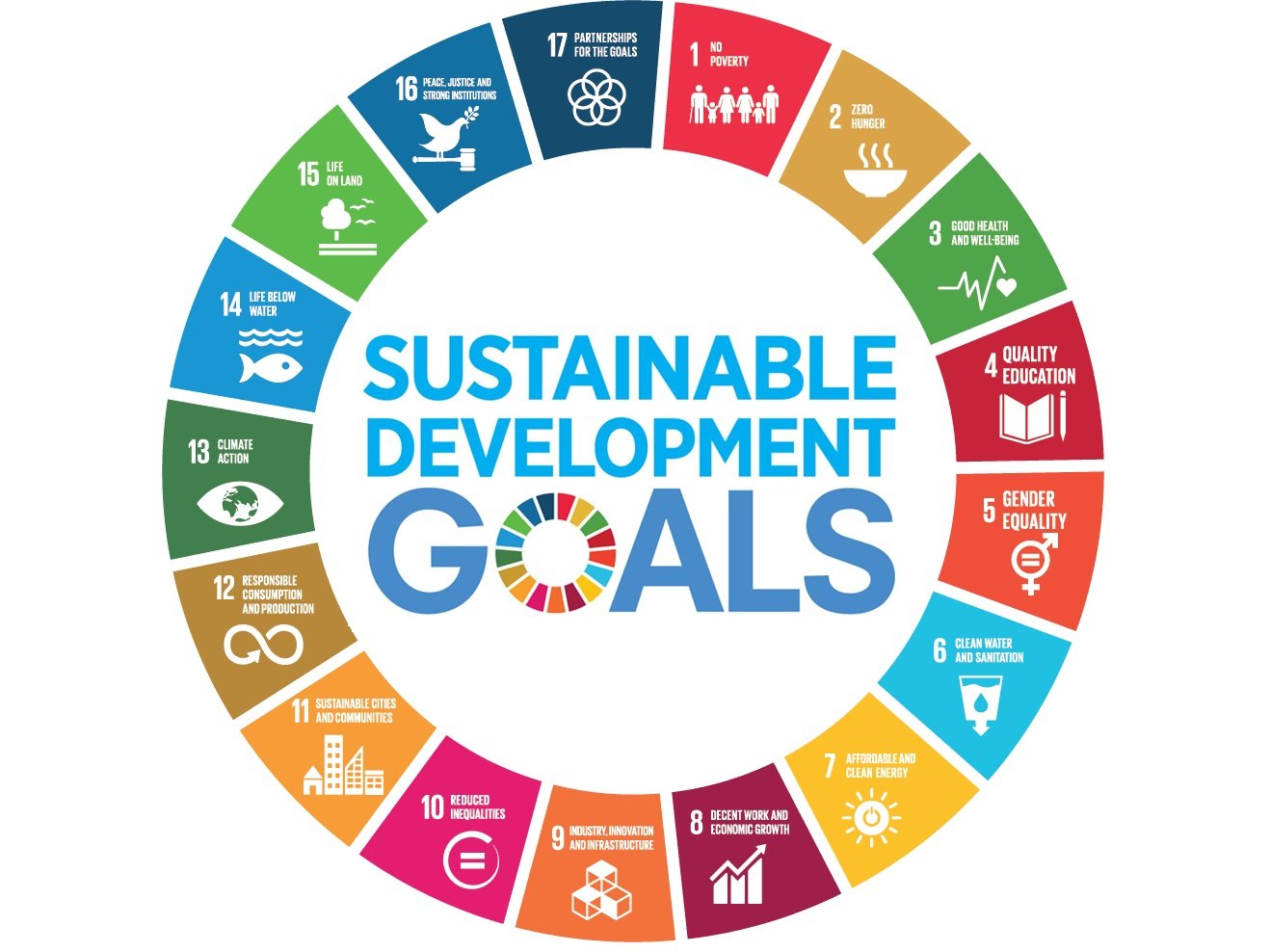
Fossil Fuel Expansion and Sustainable Development Goals
Freddie Daley & Charlie Lawrie, University of Sussex (2021)
-
![]()
Scottish Supporter Briefing: Ending the fossil fuel era. Why we need a fossil fuel treaty
Global Justice Now Scotland
-
![]()
UK Supporter Briefing: The Fossil Fuel Treaty: A global plan for a fossil free future
Global Justice Now UK (January 2024)
-
![]()
Lessons from Humanitarian Treaties for a Fossil Fuel Treaty
Mcleod, Christie (2022)
-
![]()
Briefing for Policymakers
Read briefing paper in
English | Spanish | French | Arabic | Portuguese -
![]()
Summary Flyer












Connect with us for live updates