
As the Arctic heats up at an increasingly alarming rate, Reykjavík joins the global call for a Fossil Fuel Treaty
27 February 2026
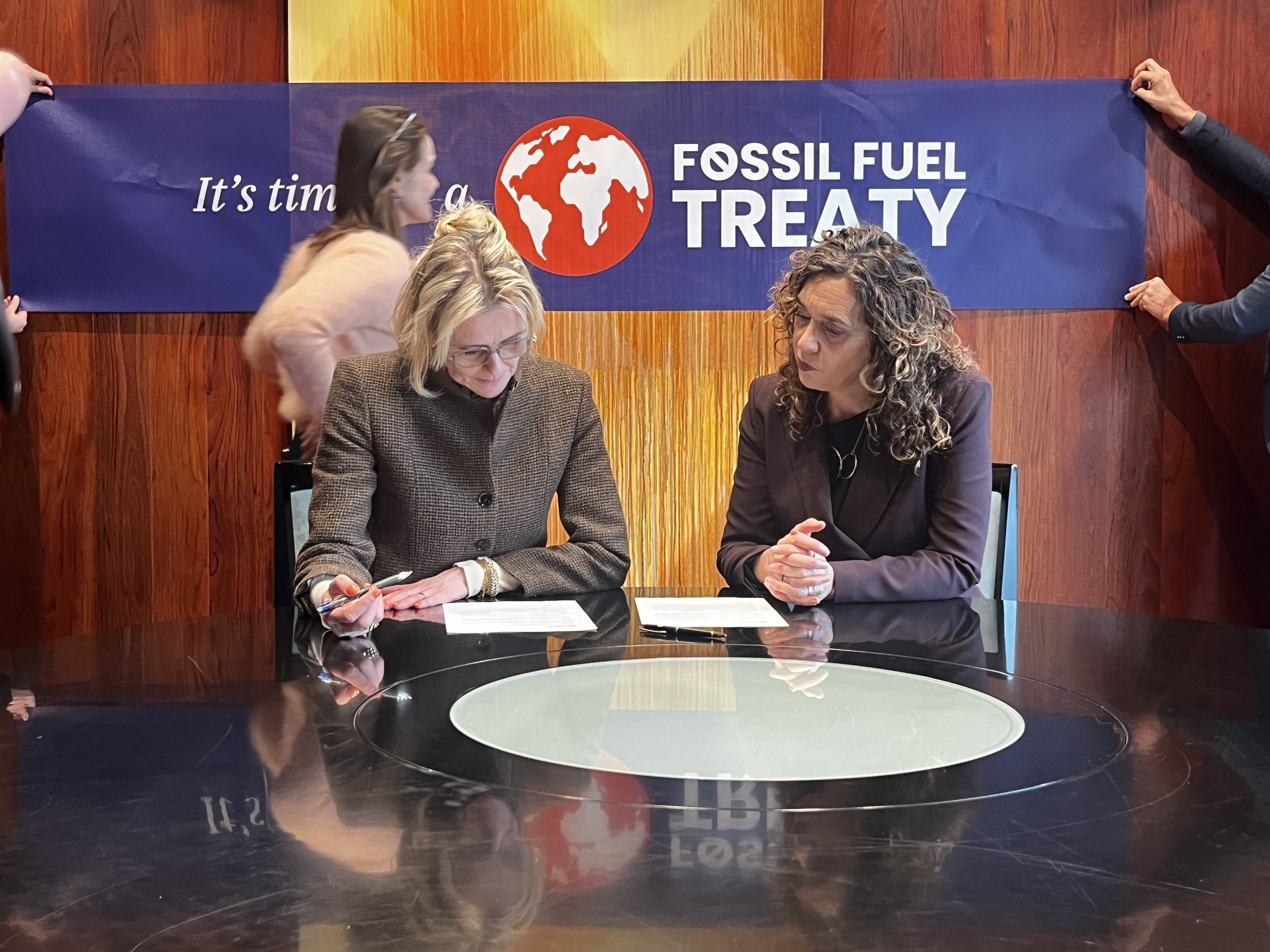
Reykjavík, Iceland, 27 February 2026 - The world’s northernmost capital, the City of Reykjavík, has formally endorsed the call for a Fossil Fuel Treaty, joining a growing movement of nearly 150 cities worldwide. Among them are European capitals like London, Copenhagen, and Paris, all urging their national governments to support the Treaty proposal, a plan for a global just transition to phase out fossil fuels.
This decision reflects Reykjavík’s long-standing climate leadership and its commitment to align local ambition with global action. With 100% of the city’s electricity generated from renewable sources and a target of climate neutrality by 2030, supporting the Fossil Fuel Treaty builds naturally on its existing commitments and strengthens Reykjavík’s voice in international climate discussions. As Iceland stands on the frontlines of the climate crisis, this endorsement sends a clear message: addressing fossil fuel production must be part of the solution.
Heiða Björg Hilmisdóttir, Mayor of Reykjavík, said: “Endorsing this Treaty aligns with Reykjavik’s existing climate goals, including climate neutrality by 2030, and builds on our leadership in clean energy, sustainable mobility, and fossil fuel free city operations. This declaration strengthens Reykjavik’s existing commitments and aligns local action with global efforts to address the root causes of the climate crisis. Reykjavik stands ready to work with other cities worldwide and encourages national governments, including the Government of Iceland, to actively participate in the international discussions on a Fossil Fuel Treaty and to contribute to shaping a global and fair transition away from fossil fuels.”
Iceland sits in one of the fastest-warming regions on Earth. Roughly 10% of the country is covered by glaciers — yet since the late 19th century, Icelandic glaciers have lost over 2,100 km² of surface area. Some, like Okjökull, have already disappeared. For Icelanders, this means more frequent glacial flooding, increased threats to roads and infrastructure, changes to hydropower production, and profound impacts on landscapes that shape their local livelihoods.
Glacier melt in Iceland is not just a local issue. As glaciers shrink worldwide, they drive sea-level rise, threaten freshwater security, destabilize ocean currents such as the Atlantic Meridional Overturning Circulation (AMOC), and accelerate global warming through feedback loops. These changes affect coastal cities, agriculture, fisheries, and infrastructure around the world. For Iceland, disruption of the AMOC would not be abstract science — it could alter fish stocks, intensify extreme weather, and threaten the economic backbone of coastal communities.
Tzeporah Berman, Founder and Chair of the Fossil Fuel Treaty Initiative, said: “We are thrilled to be here in Iceland to celebrate Reykjavík joining the call for the Fossil Fuel Treaty. Support is growing around the world and having cities come onboard is critical to encouraging nation states to come to the table. Iceland’s leadership on renewable energy is very inspiring at a moment when its leadership truly matters. From the Arctic to the Andes, glaciers are sounding the alarm. With 18 countries already backing the Treaty proposal, Iceland has the opportunity to become the first European country to join this bloc of climate pioneers and participate in the First International Conference for the Transitioning Away from Fossil Fuels in Santa Marta this April.”
Laura Sólveig Lefort Scheefer, Campaigner and Advocacy Lead for the Fossil Fuel Treaty Initiative in Iceland, added: “This endorsement reflects Reykjavík’s values and builds on decades of climate leadership. The city demonstrates that a renewable energy future is already within reach and is well positioned to help drive a growing global effort, moving beyond emissions reductions and toward a responsible and equitable phase-out of fossil fuel production. I encourage Iceland’s Minister of Environment, Energy and Climate to build on this momentum and support the Treaty Initiative.”
Reykjavík’s decision comes ahead of the First International Conference on Transitioning Away from Fossil Fuels, to be held on 24–29 April 2026 in Santa Marta, Colombia. Co-hosted by the Governments of Colombia and the Netherlands, it will be the first major international summit dedicated specifically to planning a coordinated global phase-out of fossil fuels. The conference takes place at the foot of the Sierra Nevada de Santa Marta — home to the world’s highest coastal glaciers — highlighting the shared vulnerability of glacier regions from Iceland to Latin America.
Marcela Fernandez from Glacier Nation, said: “We choose to act, bringing glaciers back to the center of the conversation. Fossil fuels and glaciers are not separate stories. If we don’t phase out fossil fuels, glaciers will not exist in the next 200 years. There is still time. But not forever.”
About the Fossil Fuel Treaty InitiativeThe Fossil Fuel Non-Proliferation Treaty Initiative is spurring international cooperation to end new development of fossil fuels, phase out existing production within the agreed climate limit of 1.5°C and develop plans to support workers, communities and countries dependent on fossil fuels to create secure and healthy livelihoods. For more information on the Fossil Fuel Non-Proliferation Treaty Initiative and proposal, access here.
Media ContactsViviana Varin
viviana@fossilfueltreaty.org
+33 6 63 48 52 67
Donate NowThe Governments of Colombia and the Netherlands have announced their plan to co-host the First International Conference for the Phase-Out of Fossil Fuels next year.
The landmark convening will take place on 28–29 April 2026, in the port city of Santa Marta, Colombia, which plays a significant role in coal exports. This will be followed by a second convening led by Pacific nation-states.
Its purpose is to advance international cooperation on transitioning away from fossil fuel extraction.
Helping ensure there is a significant presence of civil society, technical experts, trade unions and Global South governments at the conference will come with significant logistical costs. Can you help chip into our Conference fund to ensure there is a strong presence of those pushing for fast and fair transition to fossil free future in Santa Marta in April?
-
In the donation tool on this page you can select to donate in the following currencies:
Australian Dollar (AUD)
Brazilian Real (BRL)
British Pound Sterling (GBP)
Canadian Dollar (CAD)
Euros (EUR)
Indian Rupee (INR)
Mexican Peso (MXN)
New Zealand Dollar (NZD)
Swedish Krona (SEK)
Swiss Franc (CHF)
US Dollars (USD)However, if you’d like to donate in another currency please contact us at donations@fossilfueltreaty.org and we can likely help.
-
You can update your recurring donation at donorbox.org or by contacting us at donations@fossilfueltreaty.org
The Fossil Fuel Non-Proliferation Treaty Initiative is a fiscally sponsored project of Earth Island Institute, a 501(c)(3) nonprofit organization. All donations are tax deductible in the United States. Our federal tax identification number is 94-2889684. Your credit card statement will show the donation as a charge to Earth Island Institute (not our project name). Our mailing address is The Fossil Fuel Non-Proliferation Treaty Initiative, c/o Earth Island Institute, 2150 Allston Way, Suite 460, Berkeley, California, 94704. Earth Island is an environmental organization providing fiscal sponsorship to more than 75 projects. They are committed to sound fiscal management, accountability, and transparency. Earth Island is highly rated by the top charity rating services, and you can view their financial reports here.
View our impact report here.