
The World Spends Close to US$3 Trillion on War While Efforts to Address Climate Change and Foster a Just Energy Transition Face a Funding Shortfall of US$2 Trillion
28 April 2026
April 28, 2026
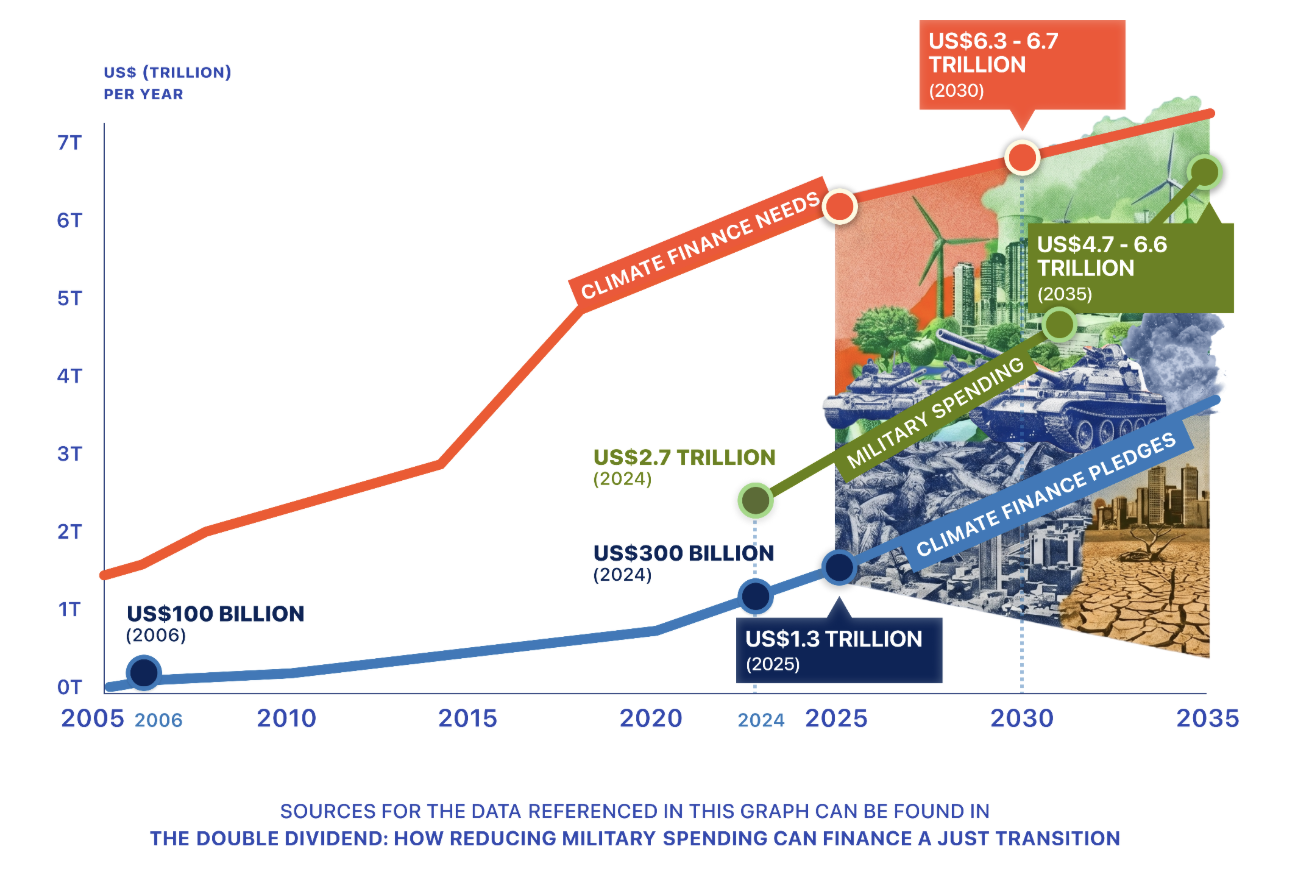
Military spending has been increasing for more than a decade, reaching US$2.7 trillion in 2024 and US$2.88 trillion in 2025. Meanwhile, there is a US$4 trillion dollar shortfall in funding needed to achieve the world’s Sustainable Development Goals and of that, a US$2 trillion funding gap for climate and energy transition action. Militarism, climate change and environmental destruction are interconnected crises. Addressing these risks requires redirecting funding away from war towards global climate justice with transitioning away from fossil fuels as a core tenant of a reallocation framework via a Fossil Fuel Treaty.
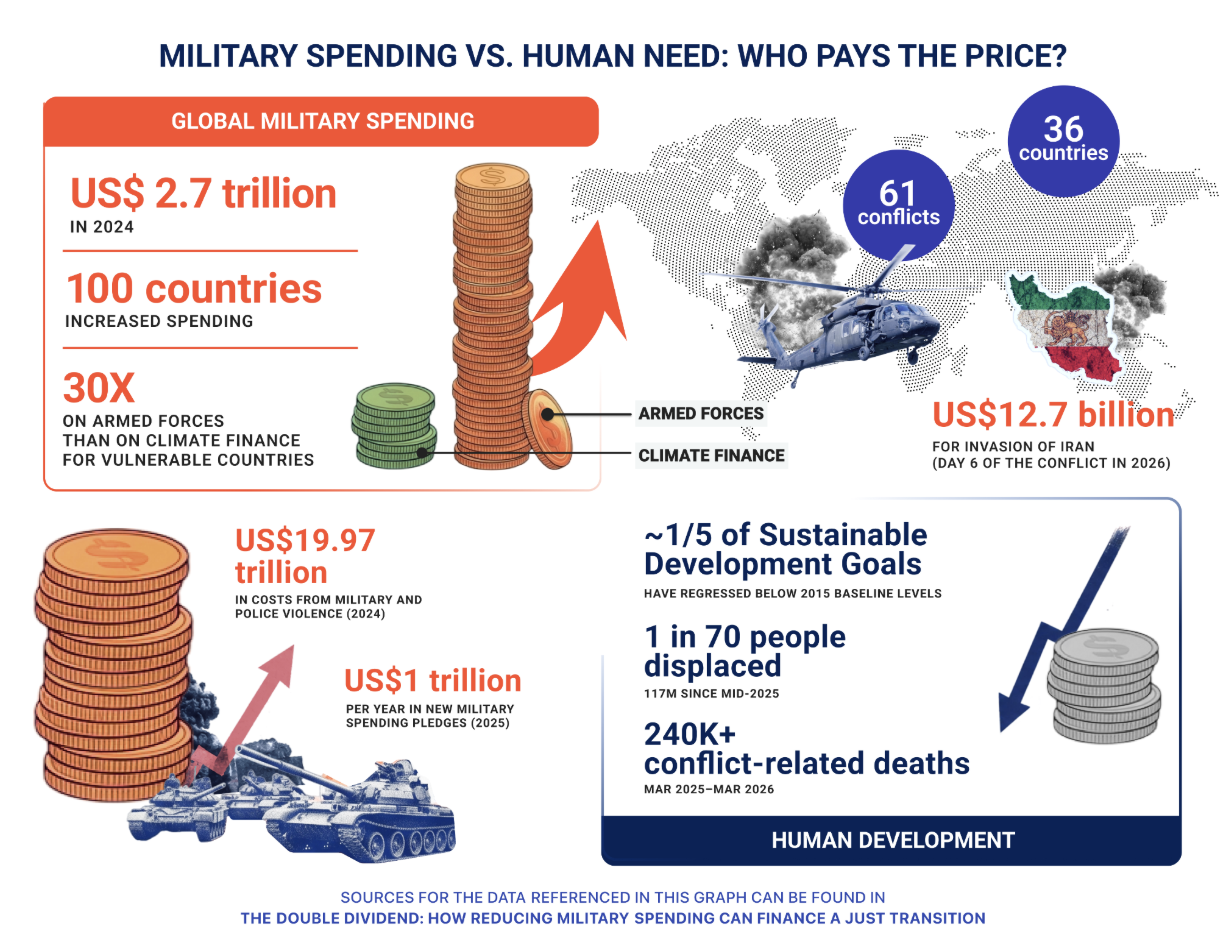
A new report, The Double Dividend: How Reducing Military Spending Can Finance a Just Transition examines the deep structural links between militarism, fossil fuel dependence and the climate crisis. It highlights that global military spending reached a record US$2.7 trillion spending by 100 countries in 2024. In 2025, this number rose to US$2.88 trillion and could reach US$4.7 to US$6.6 trillion by 2035. Spending by the largest militaries was 30 times greater than the climate finance currently being directed towards the world’s most vulnerable nations.
The Double Dividend from the Women’s International League for Peace and Freedom (WILPF) and Fossil Fuel Treaty Initiative makes the case that reducing military expenditure is one of the most significant – and most politically avoided – levers available to finance a just global transition away from fossil fuels.
Key Findings
Reducing military spending to finance a global just transition is a win-win in the current global context. The planet is warming at an unprecedented rate, and the past eleven years have been the eleven warmest on record. At the same time, armed conflict and forced displacement are also at their highest level since the end of World War II with 62 conflicts in 36 countries in 2024, more than 117 million people forcibly displaced as of mid-2025. This amount does not even reflect the human, ecological and economic costs of the expanding conflicts and genocide in the Middle East and Ukraine. As of March 2026, more than 240,000 people were killed by conflict-related violence and genocide in the previous twelve months. This is a crisis of priorities, not resources. The wealthiest countries in the world dedicate 30 times more to war than the resources being provided to countries most vulnerable to the impacts of climate change.
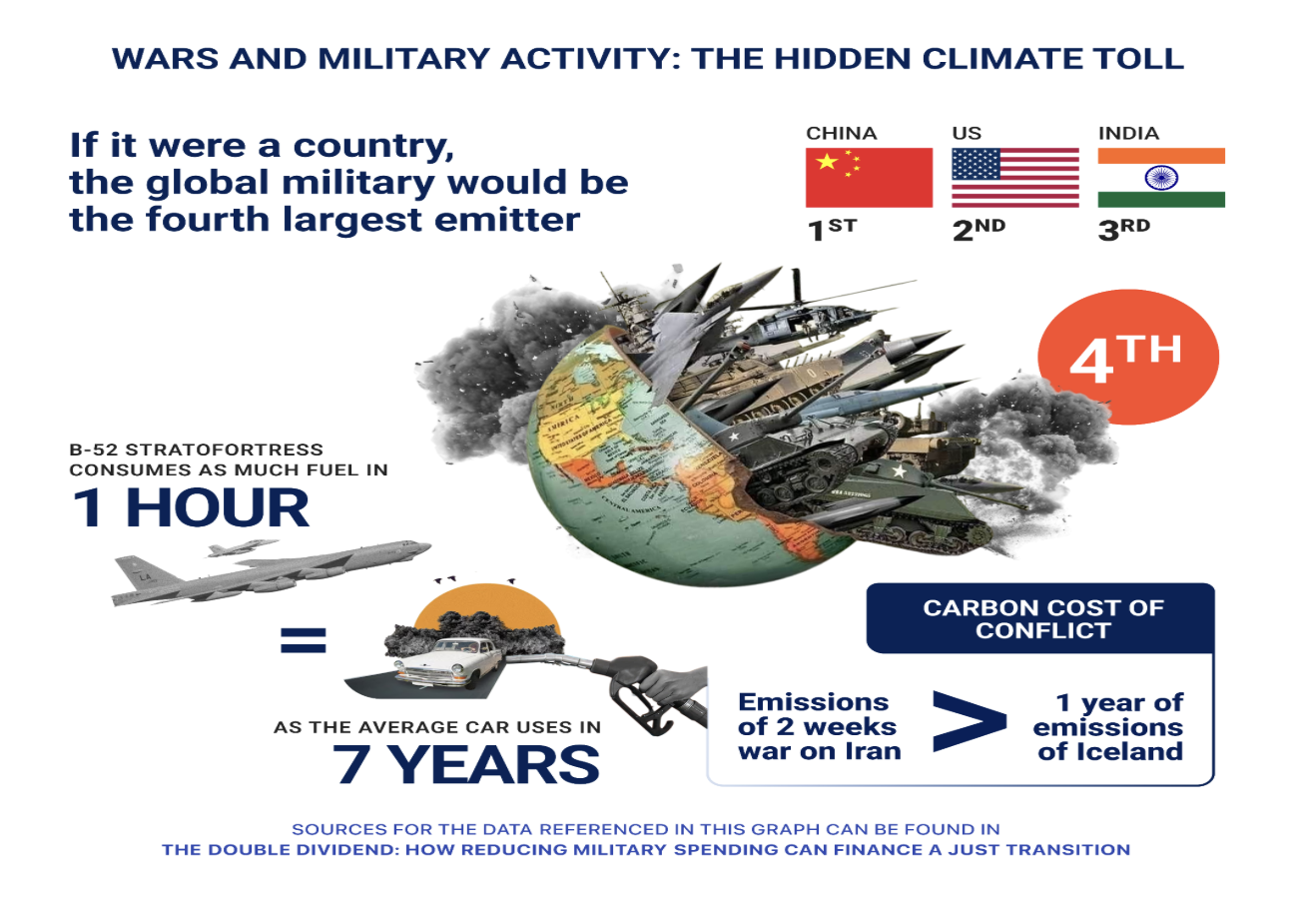
War and military activity, fueled by military spending, are among the largest, most systemic and overlooked drivers of the climate crisis. If they were a country, the world’s armed forces would be the fourth biggest carbon emitters, following China, the United States and India. Just one military jet - the B-52 Stratocruiser - consumes the same amount of fuel in one hour as the average car driver uses in seven years. Wars also have a devastating impact on the environment including soil, water, land and agricultural degradation. At the same time, climate change and environmental destruction are driving dislocation and unrest which compels further military spending in response.
Beyond pollution, militarisation undermines the conditions needed for sustainable development. Rising military spending entrenches geopolitical competition, erodes trust, weakens multilateral institutions and narrows the window for international cooperation that sustainable development and a just transition away from oil, gas and coal requires. Prioritizing military and security also means resources are diverted to that effort over other needs, such as the use of critical minerals for renewable energy.
The global cost of violence on the economy amounted to US$19.97 trillion in 2024. In contrast, ending world hunger by 2030 is estimated to cost only US$40 billion per year in comparison.
There is no credible pathway to greening militaries. Fossil fuels are the lifeblood of military systems and procurement cycles lock in this dependence for decades.
The Double Dividend report maps the financing gap for a global just transition alongside military spending, examining the latter’s impact on human security, emissions, ecological destruction and international cooperation. It outlines ways in which military spending can be reduced and reallocated towards spending for climate justice and peace and recommendations for governments and civil society on how that can be achieved including via a Fossil Fuel Treaty.
Katrin Geyer, Ecological Justice Programme Manager, Women’s International League for Peace and Freedom - “At UN climate negotiations, in academic research, in the streets, people are connecting the dots. The climate crisis and rampant militarisation are escalating together, driven by the same small group of hypercapitalist, heavily armed states that profit from both. This paper makes the case that you cannot seriously address one without confronting the other. Using the proposed Fossil Fuel Treaty as a vehicle for redirecting military spending toward the just transition, we show that the benefits would extend far beyond climate financing. Less military spending means fewer emissions, less ecological destruction, fewer wars – and more space for the diplomacy, trust and cooperation that humanity urgently needs.”
Mitzi Jonelle Tan, Youth Advocates for Climate Action Philippines - “I am from the Philippines, a country that faces some of the world's most devastating climate impacts, yet has contributed less than half a percent of global greenhouse gas emissions. Every typhoon season, entire lives and livelihoods are lost and destroyed. Global North governments claim they lack resources to help countries like mine, yet these same governments spent US$2.88 trillion on militaries in 2025. These militaries exacerbate the climate crisis and harass and threaten environmental defenders trying to protect land and nature. This is a choice being made, every year, at the direct expense of a livable future for people like me.”
Ameira Sawas, Head of Research and Policy, Fossil Fuel Treaty - “A growing, intersectional civil society movement is connecting the dots between militarism, genocide, ecocide and climate injustice. Now, more than ever, the world needs funding for a just transition and for climate justice - not for militarism and expanding violence and injustice. This must involve a concrete plan to reallocate military spending towards the just transition and peacebuilding as part of developing a Fossil Fuel Treaty aimed at ending the expansion of oil, gas and coal; winding down existing production; and accelerating a fair transition to renewable energy with community needs at the core.”
Amrita Kapur, Secretary-General, WILPF- “WILPF was born from the conviction that militarism and injustice are inseparable. In our very first resolution in 1915, we named the arms industry's private profits as a powerful obstacle to peace. Now that obstacle has grown to US$2.88 trillion a year, and it is devouring the resources the world desperately needs for climate action. The Double Dividend shows us that the choice between funding weapons and funding our planet's future is written in every line of every military budget. WILPF calls on governments to match the courage of our founders: stop pouring public money into the machinery of war and start investing in a just and peaceful world.”
Deborah Burton, Tipping Point North South- “This paper is such an important step on the journey to fully bringing the big military spending nations and their fossil fuel addicted militaries into the climate finance and just transition agendas, within the framework of the Fossil Fuel Treaty. As the planet boils, it is beyond belief that those guilty parties responsible for this climate catastrophe are pumping trillions annually into war machines. There is no better moment for this paper's release and recommendations than in Santa Marta at the First International Conference on the Transition Away from Fossil Fuels.”
Genevieve Riccoboni, Women, Peace and Security Programme Coordinator, Women’s International League for Peace and Freedom - “The crises seem to only keep growing. War, genocide, imperialist aggression, pandemics, a warming planet. Yet many governments, particularly those in the Global North, are abdicating their responsibility and are instead using this moment to continue perpetuating or allowing this violence, consolidate their power, repress the most marginalized among us and respond to every issue with militarism and securitization. Too often, the peace movement is told “now is not the time” because threats are rising. We need to interrupt this circular logic because there is no magical level at which, in a world awash with weapons, “security” will be achieved. The Double Dividend argues that now is exactly the right time to have a courageous and practical conversation about what we collectively need to do to make the space for global cooperation to advance a global just transition.”
Bridget Burns, Executive Director, WEDO - “This report shows that the climate crisis is not inevitable, but the result of political choices. A feminist approach makes clear that as impacts intensify, governments are still prioritizing militarization over care, resilience and equality. A transition that does not begin with demilitarization will not succeed.”
Harjeet Singh, global convenor of the Fill The Fund campaign and founding director of Satat Sampada Climate Foundation- “It is a profound display of moral bankruptcy that wealthy nations seamlessly mobilized a record US$2.88 trillion for weapons and warfare last year, yet claim the coffers are empty when developing countries demand climate finance. Right now, the richest countries are spending 30 times as much on their armed forces as they are on climate finance for vulnerable nations. Meanwhile, developing nations are losing hundreds of billions of dollars every year to devastating climate impacts they did the least to cause. It is time we urgently shift money away from wars and fossil fuels to address loss and damage and finally deliver genuine climate justice."
Ellie Kinney, Senior Climate Advocacy Officer, Conflict and Environment Observatory (CEOBS)- “There is a worrying current trend of governments defunding climate action to invest in record breaking levels of military spending. Meanwhile, insecurity driven by fossil fuels is playing out in conflicts across the world with devastating impacts to people and ecosystems. As this report rightly points out, the world's militaries are pushing global emissions higher, whether through the many wars being waged across the planet or through everyday military activity, infrastructure and supply chains, even during peacetime. Current levels of military spending are incompatible with peaceful and sustainable futures and a plan to address both rising militarism and our fossil fuel addiction is very welcome.”
Tasneem Essop, Executive Director, Climate Action Network International-“War kills people. So does climate collapse. And right now, the money flows in the wrong direction. Governments plead poverty on climate finance while military budgets hit record highs. This is not a funding crisis. This is a political choice. And it is costing lives. What we are witnessing - from Gaza to Cuba and across oil-rich regions - is imperialist aggression and a new colonialism, dressed in the language of security. It is not separate from the climate crisis, but part of the same system: one that extracts, concentrates power, and leaves those least responsible to pay the highest price. Real security means an end to imperialist wars, preventing climate chaos and ensuring justice for those impacted by occupation, wars and climate change.”
Karen Hallows, International Coordinator, Peace Boat & Co-lead of the Peace and Demilitarisation Working Group of the WGC- “The world’s militaries are among the largest institutional fossil fuel users and contributors to greenhouse gas emissions, while record-breaking military spending continues to drain resources away from the urgent need for a just transition. This report makes clear that real security comes from peace, climate justice and international cooperation, not from weapons and war. Redirecting even a fraction of military spending through mechanisms like the Fossil Fuel Treaty could finance a fossil fuel phase-out and help build a safer, more peaceful world for all.”
About WILPF: The Women’s International League for Peace and Freedom (WILPF) is an international non-governmental organisation founded in 1915. With National Sections in over 40 countries and an International Secretariat based in Geneva, WILPF works to bring together women and like-minded individuals committed to using nonviolent means to achieve a world free from all forms of violence and war.
About the Fossil Fuel Treaty Initiative: The Fossil Fuel Treaty Initiative is an alliance of nation-states and civil societyworking to securea global just transition from coal, oil and gas and build a safe and sustainable future for all.
Media ContactsChristine Mbithi
Strategic Communications Specialist, Fossil Fuel Treaty Initiative
christine@fossilfueltreaty.org
+254 725 906695 (WhatsApp)